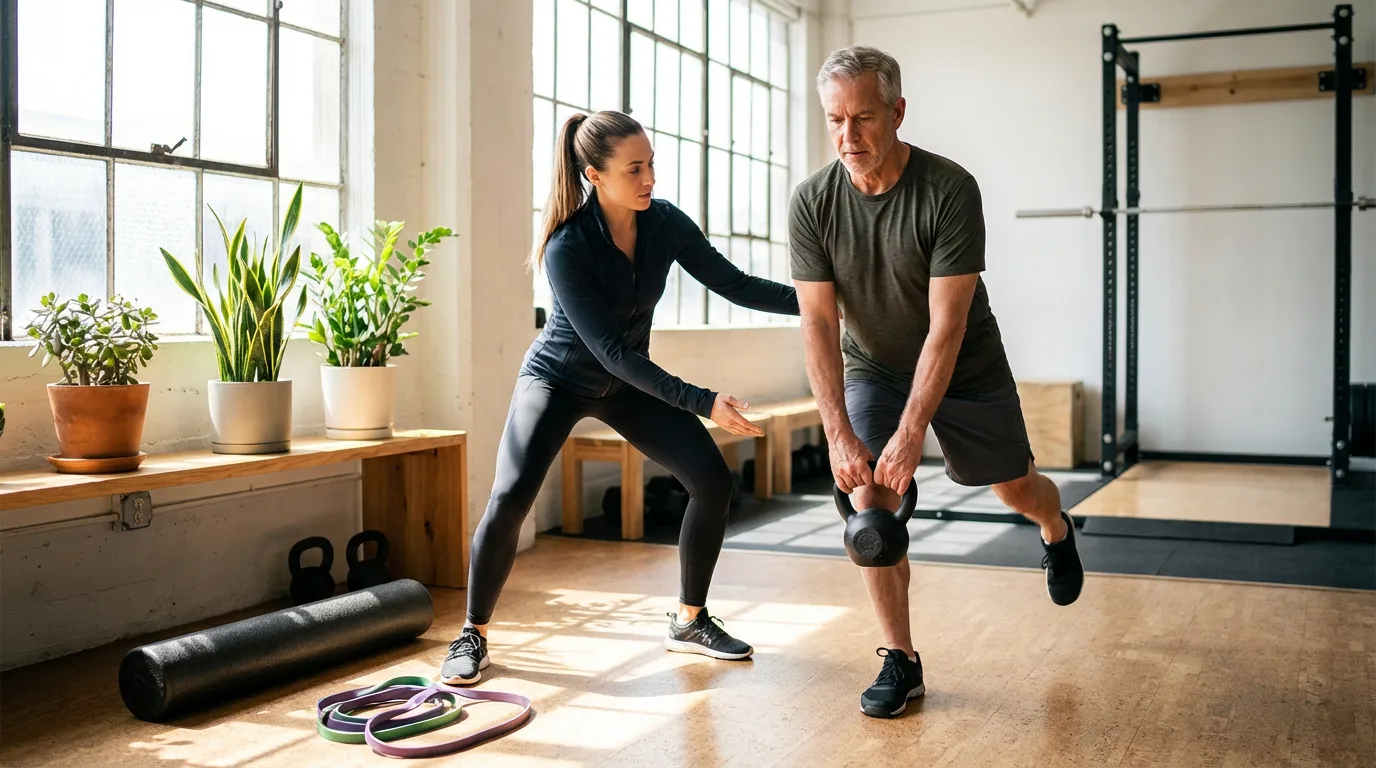
Your best client just told you she doesn’t care about losing weight anymore. She wants to be strong enough to keep up with her grandkids at 70. If you’re a personal trainer or fitness coach, you’re probably hearing this more often now. The data backs it up.
Weight loss and aesthetics are still the top reasons most people hire a personal trainer. That hasn’t changed. But a growing segment of clients is showing up with different goals: staying mobile at 70, maintaining independence at 80, building the kind of strength that lasts decades. If you’re not equipped to coach them, you’re leaving a valuable, long-retention client base on the table.
Longevity coaching means programming for healthspan, not just aesthetics. Instead of optimizing for how a personal training client looks in 12 weeks, you’re building the strength, mobility, balance, and cardiovascular capacity that keeps them independent and active for decades. A 2026 NASM survey of 600+ professionals found this is the fastest-growing client goal - not the most common, but the one growing fastest.
- The trend: 62% of trainers report longevity and healthy aging as the fastest-growing client goal, even as weight loss remains the most common
- Why now: an aging active population, GLP-1 medications normalizing weight management, and mainstream longevity content shifting what some clients expect from coaching
- What changes: programming adds functional strength, mobility, and balance; metrics shift from scale weight to grip strength, walking speed, and lean mass
- How to program: compound movements, Zone 2 cardio, balance work, and recovery as core pillars
- The business case: longevity clients stay for years, not months, and retention is where the real revenue lives
The Longevity Trend in Personal Training: What the Data Says
In January 2026, NASM published findings from a survey of over 600 fitness professionals. The key finding: 62% of trainers report increased demand for “Longevity & Healthy Aging” as a client goal, making it the fastest-growing motivation they’re seeing. Weight loss and strength training still top HFA’s consumer data as the most common reasons people hire a trainer - but longevity is the category gaining ground.
NASM CEO Mehul Patel framed it directly: “The industry is moving away from the transactional ‘burn calories’ model toward a transformational ‘build life’ model.”
A separate Life Time survey of 750+ people found similar signals from the consumer side. 42.3% named “getting physically stronger” as their primary goal - not losing weight. And 33.2% cited longevity as a health motivation, roughly on par with weight loss in HFA consumer data.
This isn’t a wholesale replacement of aesthetic goals. It’s a meaningful and growing segment that changes how you need to coach.
Why Personal Training Clients Are Shifting Toward Longevity
Three forces are converging.
An aging population that refuses to slow down. Adults over 50 are one of the fastest-growing gym demographics. They’re not training for a summer vacation. They want to hike with their partner at 65, lift their grandkids at 70, and get off the floor without help at 80. Sarcopenia - the progressive loss of muscle mass and strength - typically starts around age 40, with strength declining 1-2% per year after 50. Your 45-year-old client feels this, even if they don’t know the word.
GLP-1 medications are normalizing weight management. When weight loss becomes pharmaceutically manageable, coaching shifts to preserving muscle and building functional capacity that medication doesn’t address. We covered this in our GLP-1 coaching guide.
Longevity content has gone mainstream. Peter Attia’s “Outlive” introduced millions to concepts like Zone 2 cardio, grip strength as a mortality predictor, and exercise as “retirement savings for your body.” Your clients are arriving with more sophisticated health goals. They don’t need you to explain why strength matters. They need you to program it.
What Changes When Fitness Coaching Clients Want Longevity
When a client’s primary goal is healthspan rather than aesthetics, four things change about how you coach.
Programming: functional strength over isolation
An aesthetics client wants bigger arms. A longevity client wants to carry groceries at 75. In practice, many clients want both, and there’s more overlap than the labels suggest. But when longevity is the primary driver, the programming emphasis shifts.
Longevity programs are built around compound movements: squats, deadlifts, rows, loaded carries, and pushing/pulling patterns. Progressive overload still applies, but the goal is maintaining muscle strength and function over years, not chasing one-rep maxes. The 2026 ACSM resistance training guidelines support exactly this approach, emphasizing that consistency with compound movements matters more than complex periodization.
Layer in three components most aesthetics programs skip:
- Zone 2 cardio (2-3 sessions/week): Walking, cycling, or rowing at a conversational pace. This builds the cardiovascular base that keeps clients energetic and independent as they age.
- Mobility work (10-15 min daily): Joint function degrades without maintenance. Assign mobility flows as warm-ups or standalone routines.
- Balance training: Falls are the leading cause of injury death in adults over 65. Single-leg work, loaded carries, and unstable surfaces belong in every longevity program. Research shows functional resistance training improves balance more effectively than traditional resistance training alone.
A 30-year Harvard study found that varied programming reduces all-cause mortality by 19%, independent of volume. Longevity clients need exactly this kind of multi-modal approach.
Metrics: what to track instead of scale weight for longevity clients
The scale is the wrong scoreboard for a longevity client. So are before-and-after photos. These functional markers are what matter:
| Metric | What It Measures | Why It Matters |
|---|---|---|
| Grip strength | Overall muscular strength | Stronger mortality predictor than blood pressure (139,691-person study). A $30 dynamometer. |
| Sit-to-floor test | Functional mobility | Correlates with mortality in adults over 50. Sit down and stand up without hands. |
| Walking speed | Cardiovascular health | 1.0 m/s or higher = survival longer than expected by age and sex (34,485-person study). |
| Lean mass trend | Muscle preservation | Quarterly composition checks. The trend matters more than any single measurement. |
Track these in check-in forms alongside standard metrics, and set goals around functional markers instead of weight targets. When a client sees grip strength improving over six months, that’s more motivating than any scale number. The same principle from why scale weight misleads coaches applies doubly here.
Conversations: different topics, longer horizon
Good coaching always involves education, regardless of the client’s goal. But longevity clients tend to arrive with more questions about the science - many have read Attia or listened to Huberman - and the topics shift. Instead of explaining caloric deficits and progressive overload, you’re explaining sarcopenia, Zone 2 thresholds, and why grip strength matters more than scale weight.
NASM’s survey found 56% of professionals rate sleep optimization as the most underrated results tool. Longevity clients are especially receptive to this. The check-in conversation shifts from short-term compliance to longer-term patterns: “here’s what your sleep trend over three months tells us about recovery, and here’s how I’m adjusting this block.”
Timeline: years, not weeks
An aesthetics client has a deadline: a wedding, a vacation, a photo shoot. A longevity client has a horizon: the next 30 years. This changes the coaching relationship fundamentally.
You’re not selling a transformation. You’re building ongoing expertise. Programming evolves through phases: a strength base, then conditioning, then sport-specific work, then adjustments for life changes. Over time, you develop a deep understanding of how each client responds - what their long-term trends show and where to push versus where to pull back.
The Business Case for Longevity-Focused Fitness Coaching
Longevity clients stay longer. A client training for a 12-week cut has a built-in end date. A client training for long-term health has none.
A 3-year longevity client at $300/month generates $10,800 in lifetime value. A six-week transformation client generates $600. That’s an 18x difference from one client who stays versus one who leaves.
That math changes how you think about growth. A roster of 15 longevity clients generating steady monthly revenue beats the constant churn of replacing short-term clients every quarter.
Industry surveys suggest most trainers find client acquisition harder or plateaued compared to previous years. Retention is where the real leverage is, and longevity clients are inherently retention-friendly: their goal doesn’t expire, they value the coaching relationship over the aesthetic outcome, and they’re typically in a stable life stage with fewer reasons to churn.
Frequently Asked Questions
Do I need a longevity certification to coach these fitness clients?
No. Your existing personal training certification covers the foundational knowledge. What changes is programming focus (functional strength, mobility, balance) and conversations (education-heavy, longer time horizons). NASM and ACE offer continuing education in senior fitness and functional aging if you want to specialize, but most longevity clients are active 40-60 year-olds, not clinical populations.
How do I transition existing clients from aesthetic to longevity fitness coaching goals?
Start with the conversation. Many clients already have longevity instincts but frame them in aesthetic language. “I want to lose weight” often means “I want more energy and to feel better.” Ask what they want to be able to do in 10 years. Then adjust goals and check-in metrics accordingly. Introduce Zone 2 cardio, add a balance component, and shift the conversation gradually.
What if my fitness coaching clients still want to look good?
They can have both. Strength training, the foundation of longevity programming, also builds the physique most people want. A longevity program with compound lifts, adequate protein, and good sleep produces aesthetic results as a side effect. The difference is framing and metrics. You’re just not selling aesthetics as the primary goal.
Is longevity coaching only for older personal training clients?
No. While older adults are the obvious demographic, active 35-50 year-olds are the sweet spot: old enough to notice that recovery takes longer, young enough to build significant physical capacity, and financially stable enough to invest in long-term coaching. Don’t pigeonhole longevity as “senior fitness.”
A Growing Segment Worth Preparing For
Most of your clients will still want to lose weight or build muscle. That’s fine. But the longevity-focused segment is growing, and these clients bring something valuable: they stay. They don’t have an end date. They value the coaching relationship itself, not just the outcome of a 12-week program.
You don’t need to rebrand your entire business around longevity. But having the programming knowledge, the right metrics, and the language to serve these clients means you’re ready when they show up. Increasingly, they will.
Ready to coach for the long term? Try Assistant Coach free - goal tracking, custom check-in forms, and AI-powered trend analysis to support clients across years of coaching.
References
- National Academy of Sports Medicine. (2026). NASM Data Reveals the End of the “Before & After” Photo: Longevity Overtakes Aesthetics as Top Fitness Goal. GlobeNewsWire
- Life Time. (2025). 2026 Life Time Wellness Survey Results: Strength Training and Longevity Lead New Year Priorities. Life Time Newsroom
- Brogno, B. (2025). Aging With Strength: Functional Training to Support Independence and Quality of Life. Inquiry, 62. PMC
- Health & Fitness Association. (2025). 2025 U.S. Health & Fitness Consumer Report. HFA
- Leong, D.P., et al. (2015). Prognostic value of grip strength: findings from the Prospective Urban Rural Epidemiology (PURE) study. The Lancet, 386(9990), 266-273. PubMed
- Studenski, S., et al. (2011). Gait Speed and Survival in Older Adults. JAMA, 305(1), 50-58. PubMed
- de Brito, L.B.B., et al. (2014). Ability to sit and rise from the floor as a predictor of all-cause mortality. European Journal of Preventive Cardiology, 21(7), 892-898. PubMed
Related Posts
 Exercise Variety Beats More Volume: What a 30-Year Study Means for Fitness Coaches
The Harvard study showing varied programming reduces mortality by 19% - exactly what longevity clients need.
Exercise Variety Beats More Volume: What a 30-Year Study Means for Fitness Coaches
The Harvard study showing varied programming reduces mortality by 19% - exactly what longevity clients need.
 Why Scale Weight Misleads Coaches (And What to Track Instead)
When your clients' goals shift beyond weight, the metrics need to shift too.
Why Scale Weight Misleads Coaches (And What to Track Instead)
When your clients' goals shift beyond weight, the metrics need to shift too.