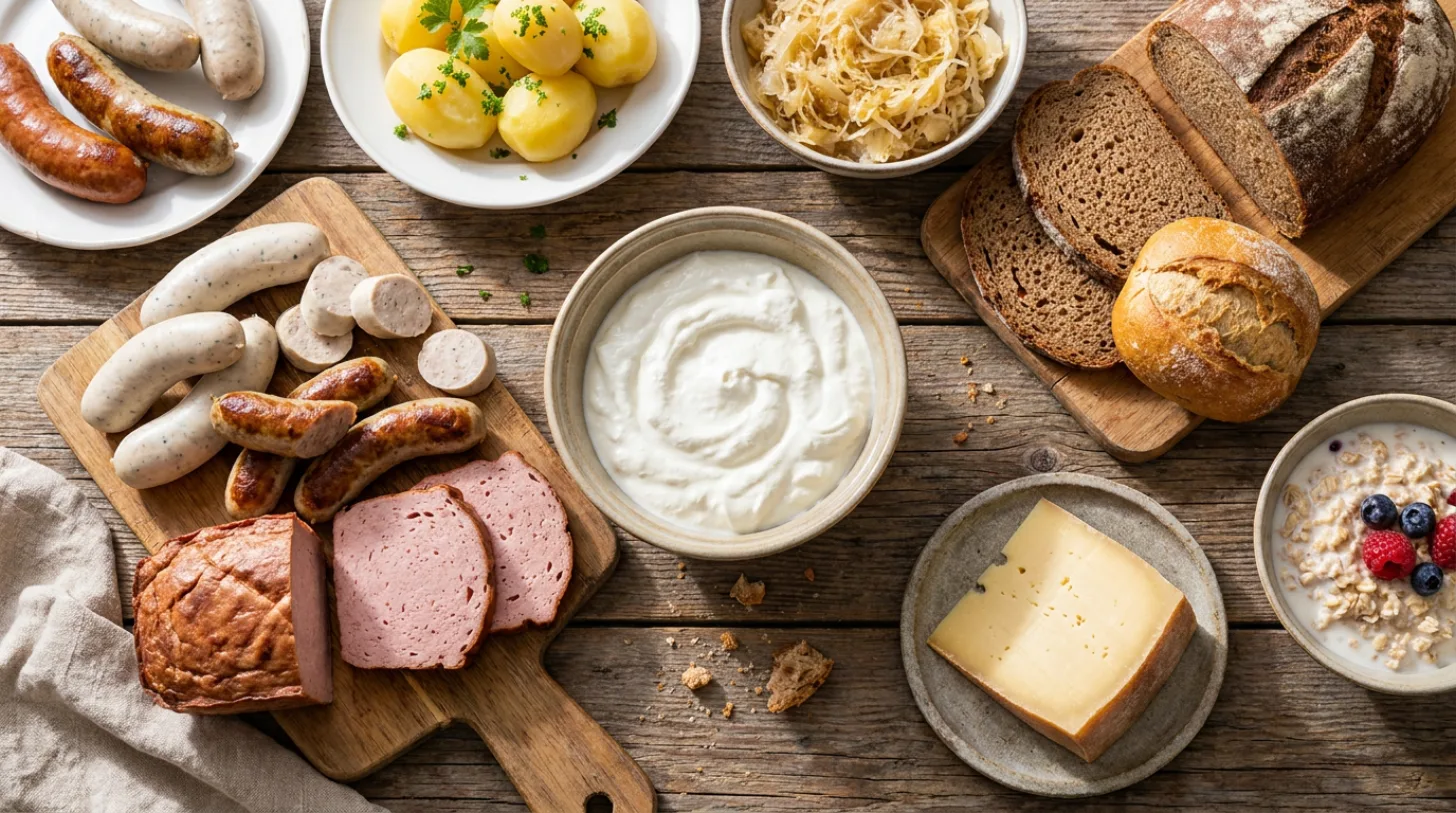
You open a German client’s meal plan to add what they actually eat. You search “Magerquark.” Nothing. You search “Vollkornbrot.” A US “whole wheat bread” shows up with numbers that do not match. So you create it by hand, type in the macros, and move on. Then the next German client eats the same quark and bread, and you do it all again.
A food database is the searchable list of foods your coaching app gives you to build meal plans. Almost every platform runs on one English, mostly American source, and it barely covers what a German client eats every day. That gap is exactly why we built regional food libraries into Assistant Coach, and the German one is 483 foods drawn from Germany’s own national nutrient database.
| What it is | An opt-in German food library inside your meal plan builder |
| How many foods | 483, from Magerquark and Vollkornbrot to Bratwurst |
| Where the data is from | The Bundeslebensmittelschlüssel (BLS 4.0), Germany’s national nutrient database from the Max Rubner-Institut |
| Who it is for | Coaches and personal trainers with clients in Germany |
| What it replaces | Building the same German staples by hand for every client |
| How to use it | Switch it on once in Settings; it stays off by default |
Here’s what this guide covers:
- Why a US food database fails German clients
- What is in the German food library
- Für Trainer in Deutschland
Why a US food database fails German clients
Food composition is not universal, and Germany’s staples show it. Quark is the clearest case: it has no clean English equivalent, so a US database either does not have it or hands you cottage cheese, which is a different food with different macros. Bread is the next trap. Vollkornbrot, Roggenbrot, and a simple Brötchen carry different numbers, and a generic “whole wheat bread” row matches none of them. The Wurst shelf, Weißwurst, Leberkäse, Bratwurst, is barely represented in an English food search.
So when a coach reaches for the closest US match, the errors stack up. A quark logged as cottage cheese, a bread that is leaner or denser than the one the client buys, a sausage approximated from something that is not quite it. Across a week, a plan that reads clean on paper drifts off target in the client’s real kitchen. And the client never sees the data problem. They just see a plan that stops working.
The fix is not to guess. It is to use Germany’s own measured food data, which is exactly what the German library does.
What is in the German food library
The library is 483 foods drawn from the Bundeslebensmittelschlüssel (BLS 4.0), Germany’s national nutrient database, published by the Max Rubner-Institut and licensed under CC BY 4.0. The macros are measured on German foods, not guessed or crowd-entered.
What that means in practice:
- Quark, the German way. Magerquark and the other Quark varieties, a dairy staple with no clean English equivalent, with German macros instead of a cottage-cheese stand-in.
- Breads by type. Vollkornbrot, Roggenbrot, and Brötchen, each with its own numbers instead of one generic “bread” row.
- The Wurst shelf. Weißwurst, Leberkäse, and Bratwurst, named the way a German coach and client actually say them.
- The daily staples. Haferflocken, Sauerkraut, Kartoffeln, and local cheeses your German client eats week in, week out.
You switch the library on once in Settings and its foods join your meal-plan search. It is off by default, so it never clutters the search of a coach who does not need it, and your core food library stays available either way.
No other coaching platform we checked ships this. Trainerize, TrueCoach, Everfit, and PT Distinction all rely on an English food search or a general recipe library. As far as we can verify, Assistant Coach is the only fitness coaching platform with a curated German food library you can switch on.
Für Trainer in Deutschland
Wenn du Ernährungspläne für Kunden in Deutschland erstellst, kennst du das Problem. Du öffnest die App, suchst nach “Magerquark”, “Vollkornbrot” oder “Bratwurst”, und findest nichts, oder du findest eine amerikanische Version mit Nährwerten, die nicht zum echten Lebensmittel passen. Also legst du alles von Hand an, ein Lebensmittel nach dem anderen, tippst die Nährwerte selbst ein und hoffst, dass deine Quelle stimmt, und wiederholst das bei jedem neuen Kunden.
Das ist keine Kleinigkeit. Quark hat im Englischen kein sauberes Gegenstück, und die meisten US-Datenbanken kennen ihn schlicht nicht, oder werfen “cottage cheese” aus, was etwas ganz anderes ist. Deutsches Brot ist ein eigenes Thema: Vollkornbrot, Roggenbrot und ein Brötchen haben jeweils andere Werte, und eine pauschale “white bread”-Zeile trifft keines davon. Und die Wursttheke, Weißwurst, Leberkäse, Bratwurst, ist in einer englischen Datenbank kaum sauber abgebildet.
Die deutsche Lebensmittelbibliothek löst das. Es sind 483 Lebensmittel aus dem Bundeslebensmittelschlüssel (BLS 4.0), der nationalen Nährwertdatenbank vom Max Rubner-Institut. Magerquark und andere Quarksorten, Brot nach Sorte (Vollkornbrot, Roggenbrot, Brötchen), die Wurstsorten mit den richtigen Namen, dazu Haferflocken, Sauerkraut, Kartoffeln und heimische Käsesorten. Die Nährwerte sind gemessen, nicht geschätzt und nicht von Nutzern eingetippt.
In der Praxis sieht das so aus: Dein Kunde isst Magerquark mit Haferflocken zum Frühstück, mittags Kartoffeln mit einer Bratwurst, abends ein Roggenbrot mit Käse, und du baust den Plan mit genau diesen Lebensmitteln, sodass Kalorien und Makros zur echten Ernährung passen. Jedes Brot mit seinen eigenen Werten, kein pauschales “bread”. Keine seltsamen Ersatzprodukte, kein “cottage cheese, 100 g” statt des Magerquarks, den dein Kunde wirklich kauft.
Du aktivierst die Bibliothek einmal in den Einstellungen, und die deutschen Lebensmittel erscheinen ab dann in der Suche, sobald du einen Plan erstellst. Du musst das nicht pro Kunde einstellen, und deine Hauptbibliothek bleibt genauso verfügbar wie vorher. Standardmäßig ist die Bibliothek ausgeschaltet, ein Coach, der keine deutschen Kunden betreut, sieht die zusätzlichen Lebensmittel also nie.
Der Punkt ist nicht, noch eine Funktion zu haben. Ein Plan aus den Lebensmitteln, die dein Kunde kennt und ohnehin einkauft, ist ein Plan, den er auch durchhält. Und ob dein Kunde den Plan durchhält, entscheidet am Ende über das Ergebnis, nicht die Zahl der Funktionen.
Frequently Asked Questions
Does Assistant Coach have German foods like Quark?
Yes. Alongside its meal plan builder and core food database, Assistant Coach has an opt-in German food library of 483 foods sourced from the Bundeslebensmittelschlüssel. Switch it on once in Settings and Quark, Vollkornbrot, and Bratwurst join your meal-plan search with German macros. It stays off by default.
Where does the German nutrition data come from?
The German food library is sourced from the Bundeslebensmittelschlüssel (BLS 4.0), Germany’s national nutrient database, published by the Max Rubner-Institut and licensed under CC BY 4.0. It measures German foods, so the macros for Quark, Roggenbrot, and Leberkäse reflect the real food rather than a US substitute.
Why doesn’t my coaching app have German foods like Magerquark?
Most coaching platforms build their food search on a single English, mostly US, food database. German staples like Magerquark, Vollkornbrot, and Weißwurst either are not in it, or appear with macros for a different food. That is why coaches in Germany rebuild the same local foods by hand for every client.
Can I build a German client’s meal plan without local food data?
You can, by creating each missing food by hand, but it is slow and the hand-entered macros are only as good as your source. A curated German library removes that setup by putting Magerquark, Haferflocken, Kartoffeln, and the Wurst shelf in the search from the start, with measured macros.
Do German foods clutter my normal food search?
No, because the library is opt-in and off by default. Turn it on and German foods join your search; leave it off and nothing changes. A coach who only works with clients outside Germany never sees Quark, the breads, or the Wurst varieties in their results.
References
- Max Rubner-Institut. Bundeslebensmittelschlüssel (BLS), the German national food composition database. blsdb.de
- Food and Agriculture Organization of the United Nations. INFOODS: International Network of Food Data Systems. fao.org/infoods
 The Regional Foods Your Coaching App Needs
 How to Build a Meal Plan Clients Actually Follow