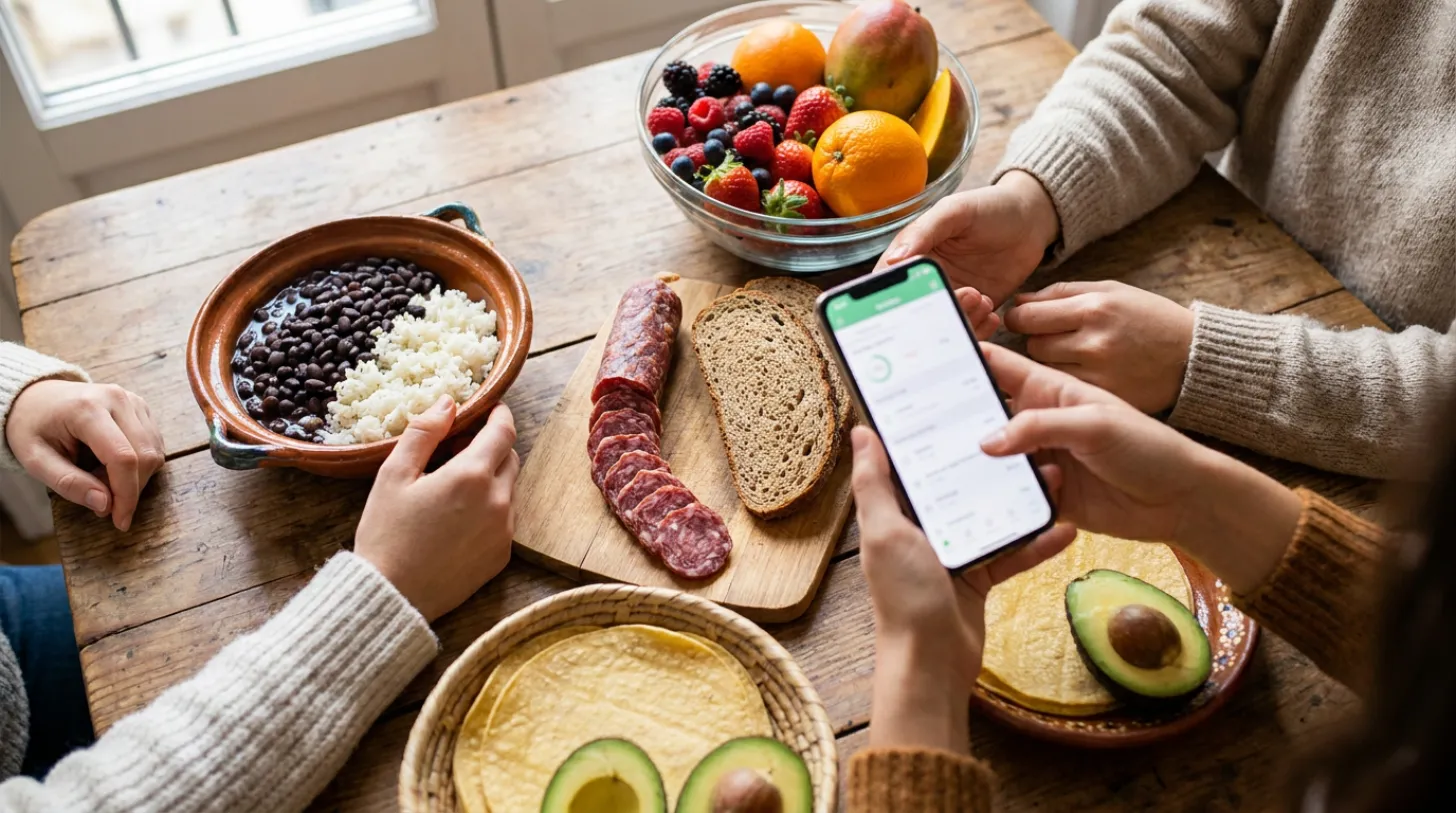
You open a client’s meal plan to swap in something they actually eat. You search for the food. It is not there. Or worse, a version of it is there, from a US supermarket, with macros that are close but not quite their food. So you do what every coach does. You create it by hand, type in the numbers, and move on. Then the next client eats the same thing, and you do it again.
A food database is the searchable list of foods your coaching app gives you to build meal plans and log intake. Almost every platform runs on one source, and that source is English and mostly American. It covers a US grocery run well. It covers feijão, Quark, arepas, and ajvar poorly or not at all. For a fitness coach or personal trainer whose clients eat regional food, that gap is a daily friction that quietly shapes how good, and how fast, their nutrition work can be. It is also fixable, and it is exactly the gap we built Assistant Coach’s regional food libraries to close, five of them so far, with more than 3,000 local foods.
| What it is | The searchable food list behind your app’s meal plans and logging |
| The common setup | One English, mostly US food database for every coach and client |
| Where it breaks | Regional foods missing, or listed with a different country’s macros |
| Who feels it | Coaches outside the US, and any coach with clients who eat local food |
| The manual fix | Building every missing food by hand, one entry at a time |
| The better fix | Opt-in regional food libraries you switch on for the markets you coach, like the five in Assistant Coach |
Here’s what this guide covers:
- Why one food database can’t serve every client
- What wrong macros actually cost a coaching client
- The hidden tax of building every food by hand
- What a regional food database looks like in practice
- Inside the five libraries
Why one food database can’t serve every client
Food composition is not universal. The same cut of beef carries different fat depending on how the animal is raised and butchered in each country. Dairy splits into local styles that have no clean English equivalent, German Quark being the classic example, a fresh cheese that is neither yogurt nor cottage cheese. And prepared dishes, the food people actually eat every day, are the most local of all. A Brazilian client’s plate of rice, beans, and farofa has no row in a US database.
This is not an oversight by the platforms. It is why almost every country maintains its own national food composition database, measured on its own foods. The United States has one. Brazil, Germany, Spain, France, Japan, and dozens more each have their own, because the numbers genuinely differ.
The trouble is that most coaching software picks one of these, the US one, and hands it to every coach in the world. For an American coach with American clients, that is fine. For everyone else, the food search is a tool built for someone else’s kitchen.
What wrong macros actually cost a coaching client
A meal plan is a set of promises about numbers. Hit these calories, this much protein, and the plan does what you designed it to do. Those promises are only as good as the food data underneath them.
When a coach substitutes a US food for a client’s real one because it is the closest thing in the search, small errors stack up. A cheese logged with the wrong fat content, a bread with the wrong carbohydrate, a cut of meat that is leaner or fattier than the local version. Across a full day and a full week, a plan that reads as 2,000 calories on paper can drift well off target in the client’s actual kitchen.
The client never sees the data problem. They see a plan that stops working. They followed it, the numbers did not add up the way you promised, and the trust you built starts to wobble. Accurate local food data is not a nicety. It is the foundation the whole plan stands on.
The other cost is subtler. When the food in the plan is not the food the client knows, adherence drops. People stick to eating patterns that fit their life and their culture. A plan built from foods a client recognizes and already buys is a plan they can actually follow.
The hidden tax of building every food by hand
Ask a personal trainer who coaches clients abroad how they handle missing foods, and the answer is almost always the same. They build them by hand. Type the name, enter the calories, protein, carbs, and fat, save it, use it. It works. It is also a tax.
Do the math on a real practice. A coach with clients in one market builds the same twenty or thirty staple local foods by hand before the real nutrition work even starts. That is time spent as a data-entry clerk instead of a coach.
There is a quieter cost too. Hand-entered macros are only as accurate as the source the coach copied them from, often a quick web search of uncertain provenance. So the manual workaround does not just cost time. It can reintroduce the exact accuracy problem it was meant to solve.
The point of coaching software is to remove this kind of repetitive setup, not hand it to the coach. Missing regional foods is one of the clearest examples of software making the coach do work the software should have done.
What a regional food database looks like in practice
The fix is not to bloat one global database with every food on earth, which would make every coach’s search noisier. It is curated regional libraries a coach switches on only for the markets they coach. That is exactly what we built into Assistant Coach.
Alongside the core food database, the meal plan builder has five opt-in regional food libraries, Brazilian, German, Spanish and Latin American, Serbian, and Indian, together more than 3,000 local foods. The four whole-food libraries take their macros from authoritative food-composition data, measured rather than guessed, so they hold up. The Indian library answers a different question, the packaged products a client picks off an Indian supermarket shelf, listed by brand with the numbers from the pack. Turn on the Brazilian library and feijão, farofa, pão de queijo, and the cuts of meat your client actually buys join your search with local numbers.
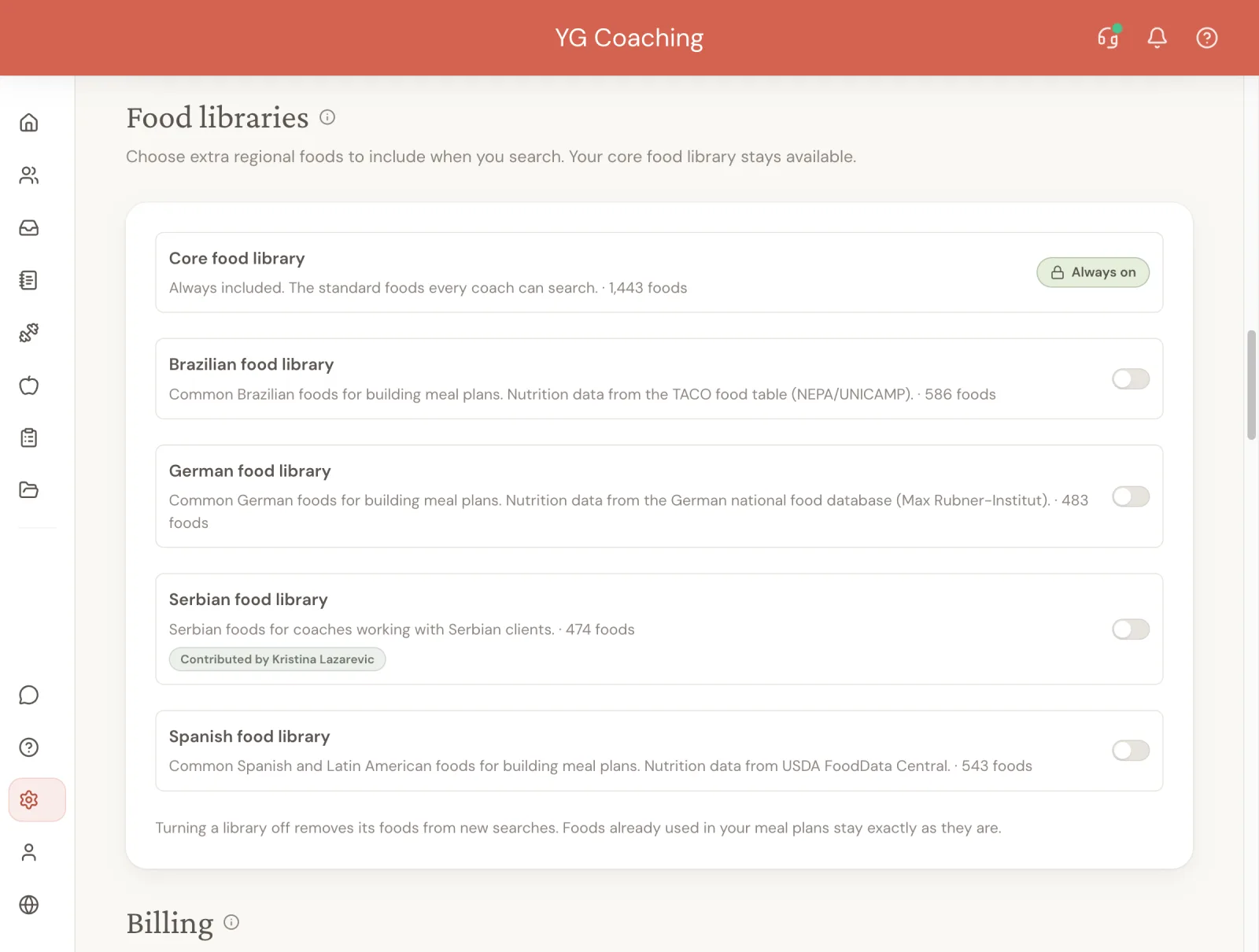
The Food libraries panel in your settings. Switch on the libraries for the markets you coach; the rest stay hidden.
The detail that makes it usable is that every library is off by default and hidden from search until you switch it on in Settings. A coach who only works with local clients never sees the extras, so nobody’s food search gets noisier. You switch on the library for the market you coach, and only then do its foods appear. It behaves like your own food database quietly grew to fit your roster, and it sits inside the rest of the workflow, structured check-ins, the workout logger with inline video review, meal and workout plan builders, goals, client notes, and full data export, not bolted on beside it.
No other coaching platform we checked ships this. Trainerize, TrueCoach, Everfit, PT Distinction, and Kahunas all rely on an English food search or a general recipe library. As far as we can verify, Assistant Coach is the only fitness coaching platform with curated regional food libraries you switch on for the markets you coach.
If you coach clients who eat regional food, the test is simple. Search your app right now for the three foods your client eats most. If they are missing, or wearing another country’s macros, that is the gap Assistant Coach’s regional libraries are built to close.
Inside the five libraries
Theory is easy. What makes a regional library worth anything is whether the foods your client actually eats are in it. Here is what is in each one today.
Brazilian, 586 foods
From the TACO table (NEPA/UNICAMP), Brazil’s own national food data. Rice and beans in the varieties clients really eat, feijão carioca and feijão preto, plus farofa, mandioca, tapioca, and pão de queijo. Cuts of meat named the Brazilian way, picanha, acém, coxa de frango, tropical fruit like açaí, mamão, goiaba, and cupuaçu, and prepared dishes down to feijoada and feijão tropeiro.
Read the full breakdown in The Brazilian Foods Your Coaching App Needs.
German, 483 foods
From the Bundeslebensmittelschlüssel (BLS 4.0), the German government’s national nutrient database. The dairy Germans actually track, starting with Magerquark, which has no clean English name. Breads by type, Vollkornbrot, Roggenbrot, Brötchen, the full Wurst shelf, Weißwurst, Leberkäse, Bratwurst, and staples like Haferflocken and Sauerkraut, each carrying the German version’s macros.
Read the full breakdown in The German Foods Your Coaching App Needs.
Spanish and Latin American, 543 foods
The widest net, one library for a client in Madrid and a client in Mexico City. The fish and seafood clients cook, merluza, atún, bacalao, gambas, pulpo, proteins like pollo, ternera, and chorizo, and legumes and grains, garbanzos, lentejas, frijoles, arroz. Tropical fruit, mango, papaya, guayaba, maracuyá, and Latino dishes such as arepa, empanada, tamal, tostones, and flan, drawn from USDA FoodData Central and curated for Spanish-speaking kitchens.
Read the full breakdown in The Spanish Foods Your Coaching App Needs.
Serbian, 473 foods
The library that started all of this, built from a real coach’s own list of the foods her Serbian clients eat. Ajvar, kajmak, and the local breads, cheeses, and cured meats a Balkan plate is actually made of. Proof that a regional library does not need a giant database behind it. Sometimes it just needs a coach who knows exactly what is missing.
Read the full breakdown in The Serbian Foods Your Coaching App Needs.
Indian, 929 packaged foods
The newest library, and the one built to a different brief. A lot of what an Indian client eats comes out of a packet, so this one lists branded products rather than raw ingredients. The Amul dairy shelf, Britannia and Parle biscuits, Haldiram’s namkeen, Maggi noodles, Epigamia and Milky Mist yoghurt, and the protein bars, peanut butters, and shakes clients pick up from Yoga Bar, The Whole Truth, and Pintola. Snacks, dairy, and drinks make up most of it, which is exactly where a coach’s estimate of a client’s day tends to drift.
These numbers come from Open Food Facts contributors, read off the packaging rather than measured in a national lab. For packaged food that is the right source, because the label is what your client is eating from.
Read the full breakdown in The Indian Foods Your Coaching App Needs.
Frequently Asked Questions
Why doesn’t my coaching app have my client’s local foods?
Most coaching platforms build their food search on a single English, mostly US, food database. It covers American supermarket items well and everything else thinly. So a coach in Brazil, Germany, Spain, or India, or any coach with clients who eat regional food, keeps hitting foods that either are not there or show macros for a different version of the food.
Are the macros in a US food database accurate for foods eaten abroad?
Often not. A cut of meat, a cheese, or a staple grain can differ in fat and moisture from its US counterpart, and prepared regional dishes usually have no US entry at all. National food databases exist precisely because composition varies by country, which is why matching a client’s real food to the right source matters for an accurate meal plan.
How do fitness coaches add foods that aren’t in their app’s database?
Usually by hand, one custom food at a time, typing in the name and the macros for every missing item. It works, but it is slow, and it has to be repeated for every client who eats the same regional foods. A curated regional library removes that tax by putting those foods in the search from the start.
Which coaching platforms have regional or non-English food databases?
Among the coaching platforms we checked, Trainerize, TrueCoach, Everfit, PT Distinction, and Kahunas, native regional food libraries in the local language are essentially absent. They rely on English food search or general recipe libraries. Assistant Coach is the one we could verify shipping curated regional food libraries as an opt-in choice.
Do regional food libraries clutter my normal food search?
They should not, if they are opt-in. In Assistant Coach every regional library is off by default and hidden from search until you turn it on, so a coach who only needs the core foods never sees them. Turn on the Brazilian library and Brazilian foods join your search; leave it off and nothing changes.
Can I coach international clients without a regional food database?
Yes, plenty of coaches do it by building custom foods and leaning on photos and descriptions. A regional database does not change whether you can coach the client, it changes how much manual setup stands between you and their first accurate meal plan. For a coach with several clients in one market, that setup adds up fast.
References
- U.S. Department of Agriculture, Agricultural Research Service. FoodData Central. fdc.nal.usda.gov
- Food and Agriculture Organization of the United Nations. INFOODS: International Network of Food Data Systems. fao.org/infoods
 When Clients Won't Track Macros
 Everfit vs Assistant Coach