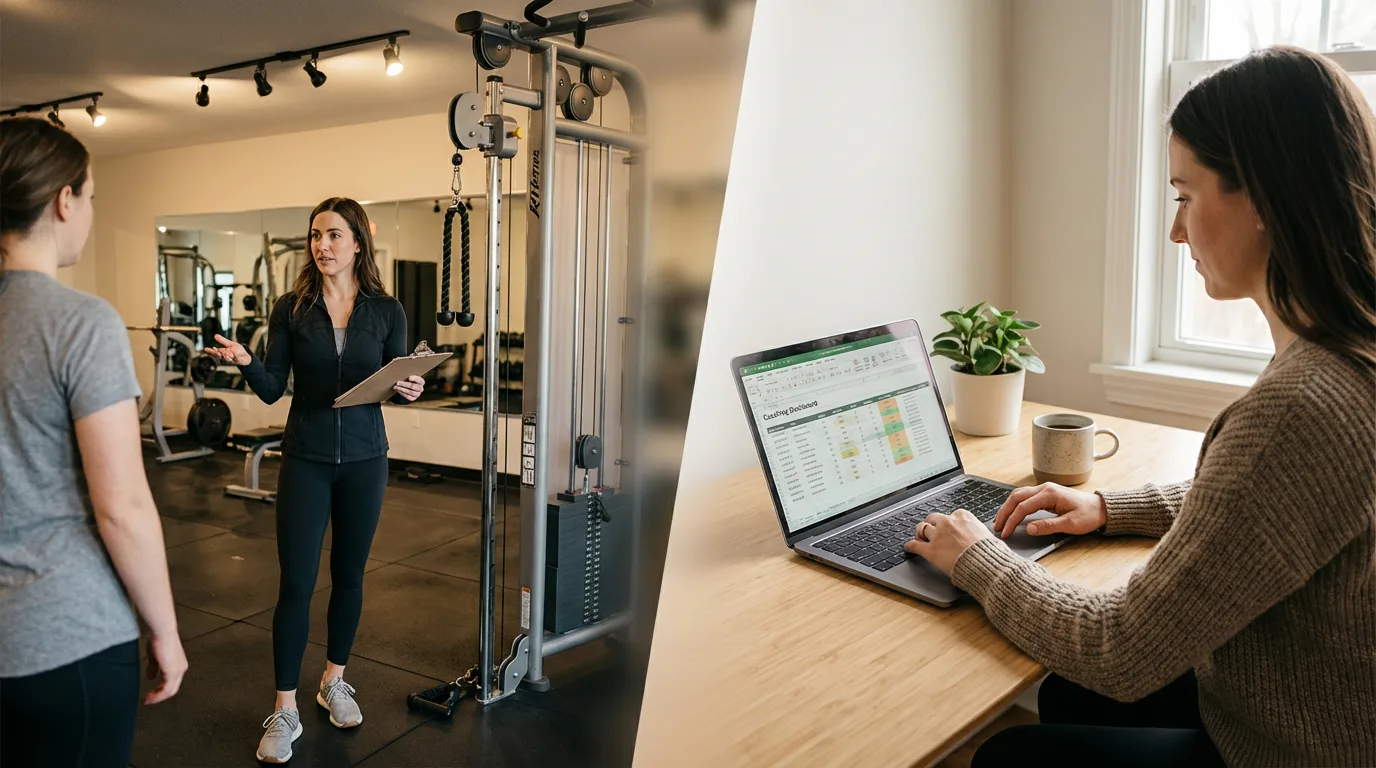
You’ve been training clients on the gym floor for years. You know how to read body language mid-set, adjust form in real time, and build rapport over chalk dust and shared effort. Now you’re watching half your industry move online and wondering if you’re falling behind.
You’re not. But the transition is real, and nobody prepares you for it.
Online fitness coaching means delivering personalized programming, nutrition guidance, and accountability to clients remotely, through software, messaging, and structured check-ins rather than face-to-face sessions. The majority of personal trainers now include some form of online delivery. A 2020 industry survey of 1,169 fitness professionals found 62% planned to adopt hybrid models, and that shift has only accelerated since. Online trainers in that survey earned roughly 52% more than in-person-only trainers ($52,518 vs $34,585 average).
- The opportunity: Online coaching uncaps your income from hours-on-the-floor. 50 clients at $200/month is $120,000/year on 15-25 hours of coaching per week
- The transition: You don’t have to abandon in-person. Start hybrid, keep your best gym clients, and build online alongside
- What changes: Delivery method, pricing model, and how you build rapport. What stays: the coaching fundamentals that made you good in the first place
- The hard parts: Finding clients without foot traffic, verifying compliance remotely, and surviving the messy middle where you’re learning both
- What you need: Coaching software, a system for check-ins, and the willingness to be bad at something new for 3-6 months
Why Personal Trainers Are Moving to Online Fitness Coaching
The shift is already well underway. Before 2020, only 7% of fitness professionals coached exclusively online. By late 2020, 21% planned to go fully online and 62% planned hybrid models. That transition has only accelerated since.
The business case is straightforward. In-person training has a hard ceiling: you trade hours for dollars, and there are only so many hours. At 25 sessions per week at $75 each, you gross about $97,000 a year. But that requires 25+ hours of active floor time, plus programming, admin, travel, and the reality that cancellations eat into that number. Most in-person trainers actually earn closer to $46,000 per year (BLS median, 2024).
Online coaching runs on a subscription model. Clients pay monthly for programming, check-ins, and ongoing support. You’re not selling an hour of your time. You’re selling access to your expertise, delivered on your schedule. The math:
| Model | Revenue | Time Required | Ceiling |
|---|---|---|---|
| In-person (25 sessions/week at $75) | ~$97K/year gross | 25+ floor hours/week | Capped by hours |
| Online (50 clients at $200/month) | $120K/year | 15-25 hours/week | Scales to 100+ clients |
| Hybrid (15 sessions + 30 online clients) | ~$130K/year | 25-30 hours/week | Best of both |
86% of fitness professionals earning six figures train clients online. That’s not because online coaching is inherently better. It’s because the business model scales, the overhead is lower, and monthly subscriptions generate predictable recurring revenue that in-person session income can’t match.
What Changes When Personal Trainers Move to Online Fitness Coaching
Delivery changes, coaching doesn’t
The biggest misconception about online coaching is that it’s a fundamentally different skill. It’s not. If you can assess a client’s needs, write intelligent programming, adjust based on feedback, and communicate with empathy, you can coach online. The skill transfers. The delivery method changes.
What’s different:
- Programming is asynchronous. Instead of cueing a client through each set, you write detailed programs they follow independently. Exercise notes, video demos, and substitution options replace real-time corrections.
- Check-ins replace sessions. The weekly check-in becomes your primary touchpoint. Clients report metrics, upload progress photos, and describe how training went. You review, respond, and adjust.
- Communication is structured. Instead of catching up during rest periods, you communicate through written responses, voice notes, and scheduled calls. This actually forces better coaching: you think more carefully about what you say because it’s written down.
- Rapport builds through consistency, not proximity. You can’t high-five a client after a PR. But you can send a thoughtful response to their check-in that references their goals from three months ago. Clients notice when their coach remembers details. Software helps with this, tracking trends and history so you’re never starting from scratch.
Pricing shifts from per-session to monthly
This is the model change that trips up the most in-person trainers. You’re used to charging per session. Online coaching doesn’t work that way. Clients pay a monthly fee for ongoing access to your coaching.
Typical online coaching rates:
- Programming only (no check-ins): $50-$100/month
- Full coaching (custom programming + weekly check-ins + nutrition): $150-$300/month
We covered how to set your rates in depth. The key insight for transitioning trainers: frame it for clients as “more coaching for less money.” Four in-person sessions at $75 is $300/month. A $200/month online plan includes programming, weekly check-ins, nutrition guidance, and ongoing messaging. The client gets more. You earn similar revenue with a fraction of the floor time.
Client acquisition changes completely
This is the hardest part. On the gym floor, clients find you. They see you training someone, they ask the front desk, they walk up mid-session. That pipeline disappears online, and you need a deliberate strategy to get fitness coaching clients without relying on foot traffic.
84% of personal training clients still come from referrals. That doesn’t change online. What changes is how those referrals find you. A client who refers a friend needs somewhere to send them. A professional coaching website with a lead form handles this better than “DM me on Instagram.”
The Fitness Coaching Transition Playbook: Month by Month
Phase 1: Test with existing clients (Month 1-2)
Don’t quit your gym job. Don’t announce a rebrand. Start by offering online coaching to 3-5 existing in-person clients who fit the profile: they travel occasionally, their schedule is inconsistent, or they’ve mentioned wanting more flexibility.
Offer them a free or discounted month of online coaching in exchange for honest feedback. This does three things: you get real feedback, you build your workflow, and you create testimonials.
Phase 2: Build your systems (Month 2-3)
Before taking on paying online clients, get your infrastructure right:
- Set up coaching software. You need a platform that handles client onboarding, check-ins, programming, and communication in one place. If you’re currently managing clients in Google Sheets, this is when you migrate.
- Create your intake form. A structured intake form replaces the initial consultation. It captures training history, goals, available equipment, schedule, injuries, and dietary preferences.
- Build template programs. Create 3-5 base workout templates for common client profiles (beginner, intermediate, home-only, 3-day, 4-day). You’ll customize these for each client rather than programming from scratch every time.
- Establish your check-in cadence. Weekly check-ins are standard. Define what clients submit (metrics, photos, training feedback) and when. Having a clear system from the start prevents the chaos of managing check-ins through scattered text messages.
Phase 3: Launch and grow (Month 3-6)
Start accepting paying online clients. Set a realistic initial capacity: 10-15 clients while you’re still refining your workflow. Price at your target rate from day one. Don’t undercharge to “test the market” because raising prices on existing clients is harder than starting right.
This is the “messy middle.” You’re coaching in-person and online simultaneously, learning new tools, and building new habits. It’s uncomfortable. That’s normal. Most trainers who successfully transition describe months 3-6 as the hardest, not because the coaching is harder, but because the business feels chaotic before systems click.
The chaos resolves when your systems mature: onboarding flows become second nature, check-in reviews get faster, and you develop a rhythm that works for both delivery models.
What You Need to Start Online Fitness Coaching
| What | Why | Cost |
|---|---|---|
| Coaching software | Client management, check-ins, programming, communication | Free-$100+/month |
| Intake form template | Structured onboarding replaces the in-person consultation | Included in software |
| 3-5 workout templates | Base programs you customize per client, not built from scratch | Your time |
| Check-in system | Weekly client reporting with metrics, photos, and feedback | Included in software |
| Professional website | Where referrals land and prospects sign up | Included in some platforms |
| Laptop + internet | Your coaching office | Already have it |
You don’t need a studio, ring lights, or video editing skills. You need systems that make coaching delivery efficient and consistent. The software comparison covers what different platforms cost.
When In-Person Fitness Coaching Is Still the Right Call
Not every trainer should abandon in-person coaching. A few honest considerations:
- If your clients need hands-on rehabilitation or clinical supervision, in-person remains necessary. Online coaching supplements but doesn’t replace physical assessment for certain populations.
- If you genuinely love the energy of training in person, going fully online will drain you. The hybrid model exists for exactly this reason.
- If your client base is primarily elderly or low-tech, the transition creates friction that may not be worth it. Meet your clients where they are.
- If you’re not willing to write, online coaching is a writing-intensive job. Check-in responses, programming notes, educational content. If you hate writing, the work will feel like a chore.
The beauty of hybrid coaching is that you don’t have to choose. Keep the in-person clients who energize you. Add online clients for scalability and flexibility.
Frequently Asked Questions
How do I tell my existing in-person clients I’m moving to online fitness coaching?
Be direct and frame it as an expansion, not a departure. Something like: “I’m adding online coaching to give you more flexibility in how we work together. Your programming and check-ins will be just as personalized, and you’ll have more options for how we connect.” Offer existing clients first access to the online model, ideally at their current rate or a loyalty discount for the first 3 months.
How much should I charge for online fitness coaching compared to in-person sessions?
Online coaching typically runs $100-$300/month for custom programming with weekly check-ins, compared to $50-$100 per in-person session. The math often works in the client’s favor: 4 sessions/month at $75 is $300, while a $200/month online plan includes programming, check-ins, and ongoing support. Position it as more coaching for less money, not a downgrade.
Can I run a hybrid fitness coaching model with both in-person and online clients?
Yes, and it’s the most common approach. The majority of personal trainers now include some form of online coaching. You don’t have to choose one or the other. Many coaches keep their best in-person clients while building an online roster for geographic reach and recurring revenue. The same software handles both.
What equipment do I need to start online fitness coaching?
A laptop, a reliable internet connection, and coaching software. That’s it. You don’t need a professional studio, fancy lighting, or video editing skills. Your clients need clear programs and responsive coaching, not production value. A smartphone for quick video check-ins and a Google account for basic communication will cover the first few months.
How many online fitness coaching clients can I manage?
Most coaches comfortably handle 20-30 online clients while maintaining quality. With efficient systems and AI-assisted check-in reviews, some scale to 50-100+. The ceiling is much higher than in-person, where you’re capped at the hours in your day. Start with 5-10 online clients to build your workflow before scaling.
References
- Bureau of Labor Statistics. “Fitness Trainers and Instructors: Occupational Outlook.” 2024.
- PTDC. “The Personal Trainer Salary Survey.” 2020.
- MyPTHub. “Personal Trainer Statistics and Trends.” 2026.
- Insurance Canopy. “Personal Trainer Annual Data Report.” 2024.
- HFA. “New HFA Data Shows How 77 Million US Fitness Facility Members Work Out.” 2025.
 How Much Should Online Fitness Coaches Charge in 2026?
 The First 30 Days: Client Onboarding for Fitness Coaches