
A meta-analysis of 138 studies and nearly 20,000 people found that tracking progress toward a goal helps people reach it, and it helps more when the progress is reported to someone else or written down. That is the whole case for client habit tracking in fitness coaching, in one line.
Client habit tracking is how fitness coaches and personal trainers track their clients’ habits between check-ins: a short list of daily behaviours, such as steps, water, sleep or how hungry they felt, that the client logs each day and the coach reads at a glance. It fills the six days a weekly check-in never sees.
What your client does each day: a tap for water, a word for hunger, a tick for the mobility routine. Shown in the Assistant Coach client app.
| What it is | A short list of daily habits your client logs, and you read |
| Why it works | Tracking progress helps people reach goals, most of all when someone else sees it |
| What to track | Numbers with a target, yes/no ticks, and word scales like energy or hunger |
| How many | Two or three per client, changed as they stick |
| What it replaces | Asking “how many steps did you average?” and getting a guess |
| What it asks of you | A glance at each client’s week, not a daily reply |
Here’s what this guide covers:
- Why fitness coaching clients need more than a weekly check-in
- What habits should personal training clients track?
- How to keep clients accountable without chasing them
- How to keep clients motivated when a habit slips
- How a client habit tracking app works in Assistant Coach
If you’d rather watch than read, here’s the whole thing in two minutes, your side first and then your client’s phone:
Prefer YouTube? Watch it on the channel here. Jump to the part you need:
- 0:10 - Spot what’s slipping
- 0:37 - Add a habit in one click
- 0:52 - Make your own
- 1:25 - How your client logs it
Why fitness coaching clients need more than a weekly check-in
A weekly check-in asks a client to remember seven days at once. “How was your sleep?” gets “pretty good.” “Average steps?” gets a round number. Memory is not a reliable tracker: a systematic review covering 187 studies found that what adults report about their own activity agrees only low to moderately with what devices measure, and it misses in both directions.
That matters most in the weeks you need the truth. The client who slept five hours on Tuesday and Wednesday, skipped two walks and got hungry every afternoon will still write “busy week, mostly on track” on Sunday.
A daily record fixes that without adding a call or a message. By check-in day the week is already written down, so your check-in reply starts from what happened, not from what they remember.
What habits should personal training clients track?
Track the two or three behaviours that most drive the client’s current goal. Every habit falls into one of three kinds:
| Kind | Examples | Why this kind |
|---|---|---|
| A number with a daily target | 10,000 steps, 2.5 L of water, 7 hours of sleep, no more than 2 coffees | You see how close they got, not just yes or no |
| A yes/no tick | A 10-minute walk after dinner, taking their vitamins, a mobility routine | For things that are simply done or not |
| A word scale | Energy, mood, stress, hunger, digestion | For how the day felt, which no device can measure |
Start small. A fat-loss client might track steps and hunger. A client with a desk job and a sore back might track steps and a daily mobility routine. Pair each habit with the goal it serves, the way every client goal needs a weekly habit behind it, and only add a third once the first two are routine.
Word scales are the ones coaches skip, and they are often the most useful. “Very hungry” three afternoons in a row tells you more about a stalled fat loss phase than another week of weigh-ins.
How to keep clients accountable without chasing them
Client accountability is not a coach sending reminders. The research above is specific about what works: progress that is recorded, and seen by someone else. So make the record take the client seconds a day, and read the whole week once, by exception:
- On target most days. A line of acknowledgement in your check-in reply. Noticed wins compound.
- One off day. Normal. Mention it lightly or not at all.
- Two or more misses on the same habit. Ask what got in the way. The answer usually changes the plan, not the client.
Accountability is a record someone reads, not a coach who chases. Two or three daily habits your client logs in seconds, and a week you glance at on check-in day, does more than a dozen reminder messages.
How to keep clients motivated when a habit slips
Clients rarely lose motivation in one bad week. They lose it when a bad week turns into a sense of failure. Habit research is reassuring here: in Lally and colleagues’ 2010 study, missing a single day made little difference to building a habit, while repeated misses added up.
So protect the second day, not the streak. A few coaching moves that keep a client going:
- Shrink the habit before you drop it. If 10,000 steps keeps missing, try 7,000 for two weeks. A target they hit beats one they fail.
- Make progress visible. A client who can see a month of mostly-green days has proof they are the kind of person who does this.
- Avoid streaks that reset to zero. A counter that punishes one missed day turns an ordinary bad week into a reason to quit.
- Talk about the pattern, not the day. “Tuesdays keep going sideways, what’s happening then?” helps. “You missed Tuesday” doesn’t.
For the harder conversations, a kind reply to a bad week does more to keep a client than any tracker.
How a client habit tracking app works in Assistant Coach
In Assistant Coach, daily habits sit alongside the rest of the coaching workflow: structured check-ins, the workout logger with video review, meal and workout plan builders, goals and client notes. You give each client a short list from their profile, starting from steps, water or sleep or writing your own, and you choose the kind: a number with an at-least or at-most target, a yes/no tick, or a word scale such as energy, stress or hunger. Each client can have up to 12 habits, and steps, water and sleep, plus scales for energy, stress, mood, hunger and digestion, are ready to add in one click.
Your client sees a Today card at the top of their client app, and each answer takes a tap, a number or a word. On their profile, you see the whole week against each target:
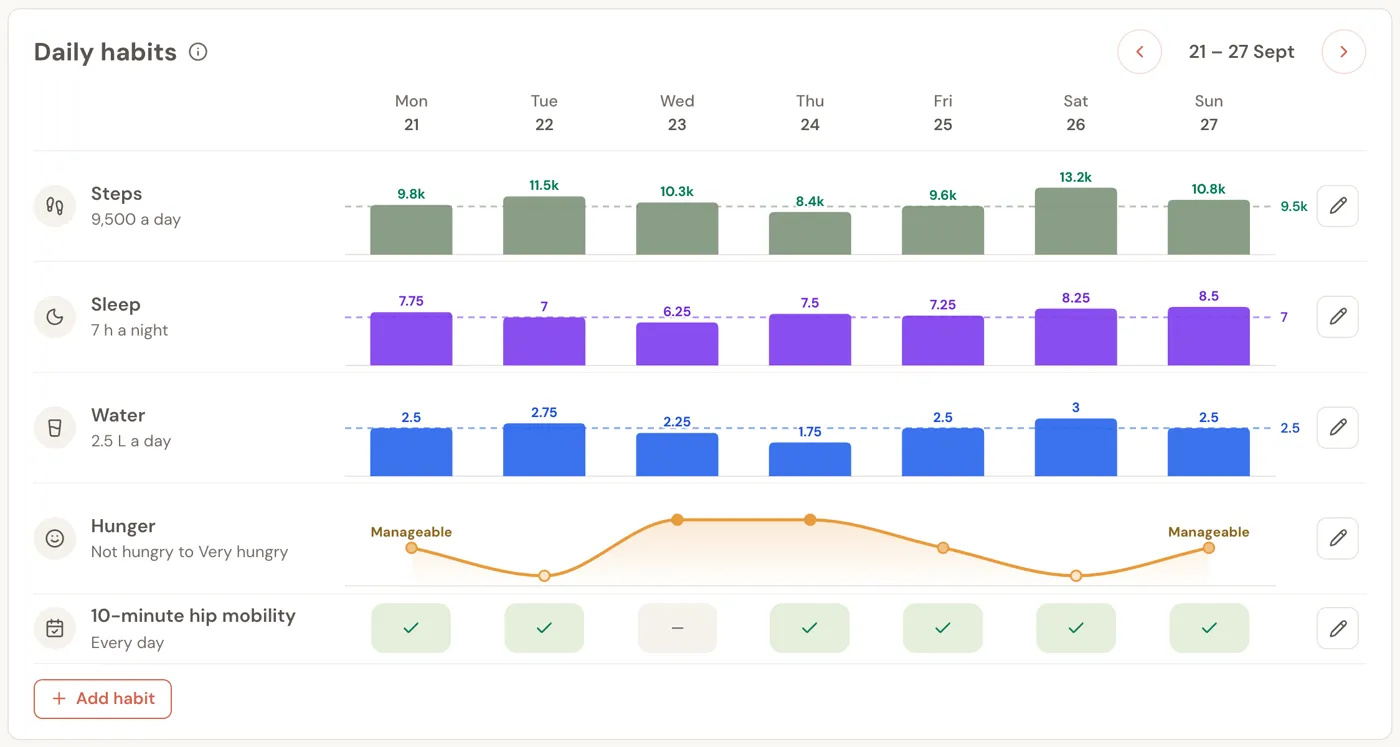
What you see: each habit against its target, day by day, with hunger drawn as a simple trend. Shown in the Assistant Coach platform.
Your client gets their own view too. The Today card shows what is left for the day, and “See your progress” opens their week and a month for each habit:
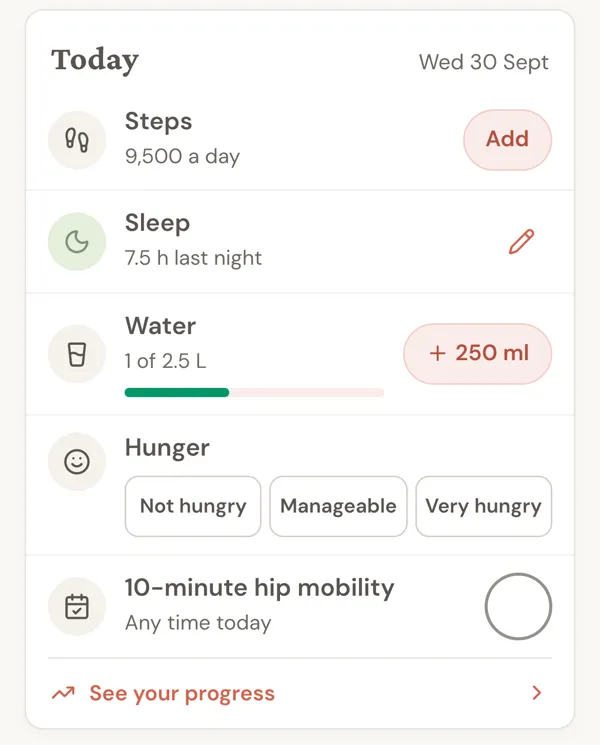
The Today card, halfway through the day. Shown in the Assistant Coach client app.
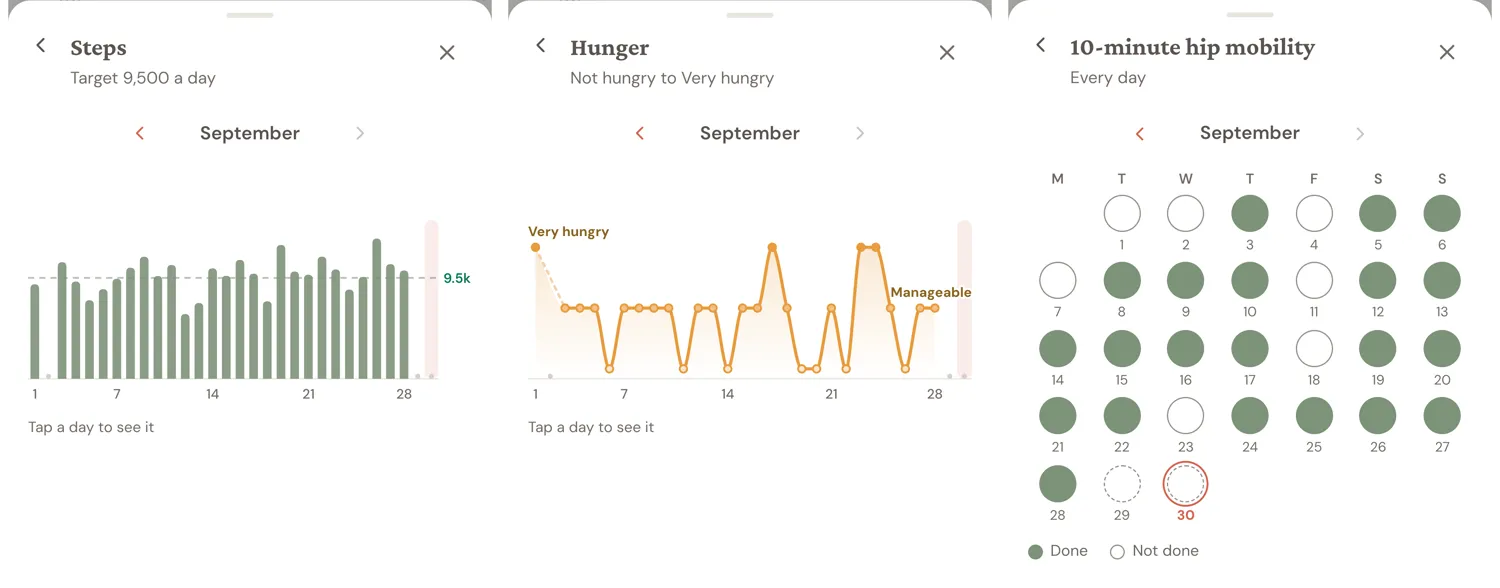
A month of steps, hunger and a yes/no habit, each drawn the way it reads best. Shown in the Assistant Coach client app.
Adding or changing a client’s habits sends them one quiet notification in their app, never an email. The daily habits guide walks through setting them up.
Frequently Asked Questions
What is the best habit tracking app for coaching clients?
One your client already opens and you can actually see. A separate habit app keeps the record on the client’s phone, so you still rely on what they tell you. Look for three kinds of habit (numbers with a target, yes/no ticks, and word scales like energy or hunger), a quick daily view for the client, and a week-at-a-glance view for you inside the same platform as their check-ins and plans.
How do personal trainers keep clients accountable between sessions?
Give the client a small daily record that someone else sees. In a meta-analysis of 138 studies, tracking progress helped people reach their goals, and it helped more when the progress was reported to someone or recorded in writing. Two or three daily habits the client logs in seconds, read by their coach once a week, is accountability without chasing.
How many habits should a coaching client track at once?
Two or three. Pick the behaviours that most drive the client’s current goal, such as steps and protein for fat loss, or sleep and a mobility routine for a client who is always sore. Add a new habit only once one of the first ones has stuck, and swap habits that stop being useful.
How do you keep online coaching clients motivated?
Make the next step small and make progress visible. A short daily list the client can finish in seconds, a week they can see filling in, and a coach who notices both the good days and the slip, early and without blame, keep motivation going better than pep talks or streaks that reset to zero.
What is the difference between habit coaching software and a habit tracker app?
A habit tracker app is built for one person tracking themselves. A habit coaching app, or habit coaching software, is built for a coach: you set the habits for each client, the client logs them, and you see every client’s week in one place, next to their check-ins, workouts and nutrition, so the habits feed your coaching instead of sitting in a separate app.
What habits should a fat loss client track every day?
Steps against a daily target, water, and sleep are the common three, because they are easy to measure and move with results. Add one habit tied to the client’s weak spot, such as a protein target, a daily walk after dinner, or how hungry they felt, and leave the rest to the weekly check-in.
References
- Harkin, B., Webb, T. L., Chang, B. P., et al. (2016). Does monitoring goal progress promote goal attainment? A meta-analysis of the experimental evidence. Psychological Bulletin, 142(2), 198-229. doi.org/10.1037/bul0000025
- Prince, S. A., Adamo, K. B., Hamel, M. E., et al. (2008). A comparison of direct versus self-report measures for assessing physical activity in adults: a systematic review. International Journal of Behavioral Nutrition and Physical Activity, 5, 56. doi.org/10.1186/1479-5868-5-56
- Lally, P., van Jaarsveld, C. H. M., Potts, H. W. W., & Wardle, J. (2010). How are habits formed: Modelling habit formation in the real world. European Journal of Social Psychology, 40(6), 998-1009. doi.org/10.1002/ejsp.674
- Assistant Coach Help Center. (2026). Daily habits
 Why Fitness Coaching Goals Fail Without Weekly Habits
 The Client App That Keeps Fitness Coaching Clients