
What should you actually say when a client’s check-in lands? You usually know what you think about their week within a minute of opening it. The hard part is the reply: saying it so the client reads it in thirty seconds, feels seen, and knows what to do before next week.
In online coaching, a check-in reply is the feedback a fitness coach or personal trainer sends after reviewing a client’s weekly check-in. A good one does two jobs: it shows the client you saw their week, and it gives them one clear next step. Here is the short version for the five weeks every coach sees:
| Week type | What the client needs to feel | Open with | One next step |
|---|---|---|---|
| Great week | You saw exactly what they did | The habit behind the result | Repeat what worked, no new targets |
| Bad week | One week doesn’t undo the plan | What they still did | The smallest action that restarts the routine |
| Plateau | A flat number isn’t failure | The trend and the signals still moving | One more week of data or one change, with the reason |
| Partial or missed check-in | You noticed, and you’re not annoyed | Thanks for what they sent | Make next week’s check-in easy |
| Life got in the way | The plan bends around their life | The life event, before any numbers | A scaled-down minimum week |
Here’s what this guide covers:
- How to respond to client check-ins as a fitness coach
- Fitness coaching check-in message examples by week type
- How long should a check-in reply be?
- How personal trainers keep replies personal with a full roster
How to respond to client check-ins as a fitness coach
One model from research on online health programs, supportive accountability, argues that people stick with a program when they feel accountable to a coach they see as trustworthy, caring, and expert, with clear expectations they helped set (Mohr et al., 2011). Your reply is where the client decides whether you are that coach.
Content matters too. A 2020 meta-analysis of 435 feedback studies in education found that feedback explaining what happened and what to do next had about four times the effect of simple reward or punishment, and it notes that praise aimed at the person works least (Wisniewski, Zierer & Hattie, 2020). “Great week, keep it up!” is a reward. It doesn’t say what to keep doing.
A reply that does both jobs has four parts:
- One specific thing you noticed. A detail only someone who read the check-in would know, like the steps they kept up on a late-shift day. This is what makes a client feel seen.
- What it means. Link the week to their goal in a sentence or two. Read the trend, not one number, because scale weight alone can mislead you.
- One next step. The one change that matters most, made concrete: when, where, how much. Plans written as “when X happens, I’ll do Y” had a medium-to-large effect on reaching goals across 94 independent tests (Gollwitzer & Sheeran, 2006). Save any second step for next week.
- An open door. A question they can answer in a line. “How did the new split feel on your knee?” beats “Let me know if you have any questions.”
Fitness coaching check-in message examples by week type
Here is that structure for the five weeks in the table. The clients are made up; make the words yours.
Great week
Priya, week 6 of a fat-loss phase: four of four sessions, weekly average down 0.6 kg, and “Sunday meal prep actually happened.”
Priya, Sunday prep happened and it shows: four sessions out of four and your weekly average down 0.6 kg. That’s the pace we want, steady enough to keep. Nothing changes this week. Same Sunday prep, same four sessions. What made Sunday easier this time?
Bad week
Tom: two of four sessions, a weekend of takeaways, and “sorry, total write-off.”
Tom, it wasn’t a write-off. You still trained twice and checked in honestly, which is the part most people skip. One weekend doesn’t undo six weeks. This week, just the Monday and Thursday sessions, and one planned takeaway on Saturday. What made the weekend hard?
For the longer version, see what to say to a client after a bad week.
Plateau
Aisha: weight flat at 71 kg for three weeks, waist down 1 cm, squat up 5 kg, and “is this even working?”
Aisha, fair question, so here’s the honest read. The scale has sat at 71 kg for three weeks, but your waist is down 1 cm and your squat is up 5 kg. Your body is changing even though the scale isn’t. Let’s run one more week as it is, with a waist measurement on Sunday. If both numbers stall, we adjust calories. Sound fair?
Partial or missed check-in
Dan sent his weight and nothing else, three days late.
Thanks for the weigh-in, Dan. 84.2 kg is right in line with the last two weeks. You don’t need the whole form every time. On a busy week, just send your weight and how many sessions you got in. How did training go?
If nothing arrives at all, send a short, guilt-free nudge rather than silence. If half-finished check-ins keep coming, shorten the form before blaming the client.
Life got in the way
Maria: her dad is in hospital, one session, no food logged, and “I’ll be back on it next week.”
Maria, I’m so sorry about your dad. Look after him and yourself first; training can wait. This week the plan is the minimum: two short walks, and one session only if you have the energy. Nothing to track. Send me a thumbs-up on Sunday so I know you’re OK, and we’ll build back up when you’re ready.
How long should a check-in reply be?
For most weeks, four to eight sentences, roughly 60 to 150 words: enough for the four parts, short enough to read on a phone in under a minute. That’s a coaching rule of thumb, not a research finding. Go longer only when you change the plan, because the client needs the reason as well as the change.
Predictability beats speed. Tell clients when to expect your reply, say within one working day, and keep that promise. The best time to set it is in the first 30 days.
Short replies can also read colder than you mean. In one experiment, people who typed sarcastic or serious statements expected readers to tell which was which, and readers did no better than chance. Listeners to recorded statements got nearly three-quarters right, and the typists didn’t see that gap coming (Kruger et al., 2005). So write the warmth in: their name, “proud of this,” “fair question.”
When to say it instead of typing it
Some replies land better heard than read: difficult news, encouragement after a hard week, or explaining why you are changing the plan. In Kumar and Epley’s experiments, conversations that included voice built stronger connection than text-based ones, without the awkwardness people expected (ScienceDaily summary). For when a recorded message is worth it, see voice notes for fitness coaching clients, and for platforms that support them, coaching apps with voice feedback.
How personal trainers keep replies personal with a full roster
The structure is simple. Doing it twenty-five times on a Sunday evening is not: by the twentieth reply, the specific detail turns into “great week!” and the next step disappears. Two habits help.
Write the reply where the check-in is. When the client’s numbers, photos, and words sit beside the reply box, the specific detail is in front of you. In Assistant Coach, the coach reply lives on the check-in screen. You can add up to four photos and draw on them, and attach a voice note of up to five minutes. The client gets a notification and reads or hears the reply in the client app, under the check-in it’s about.
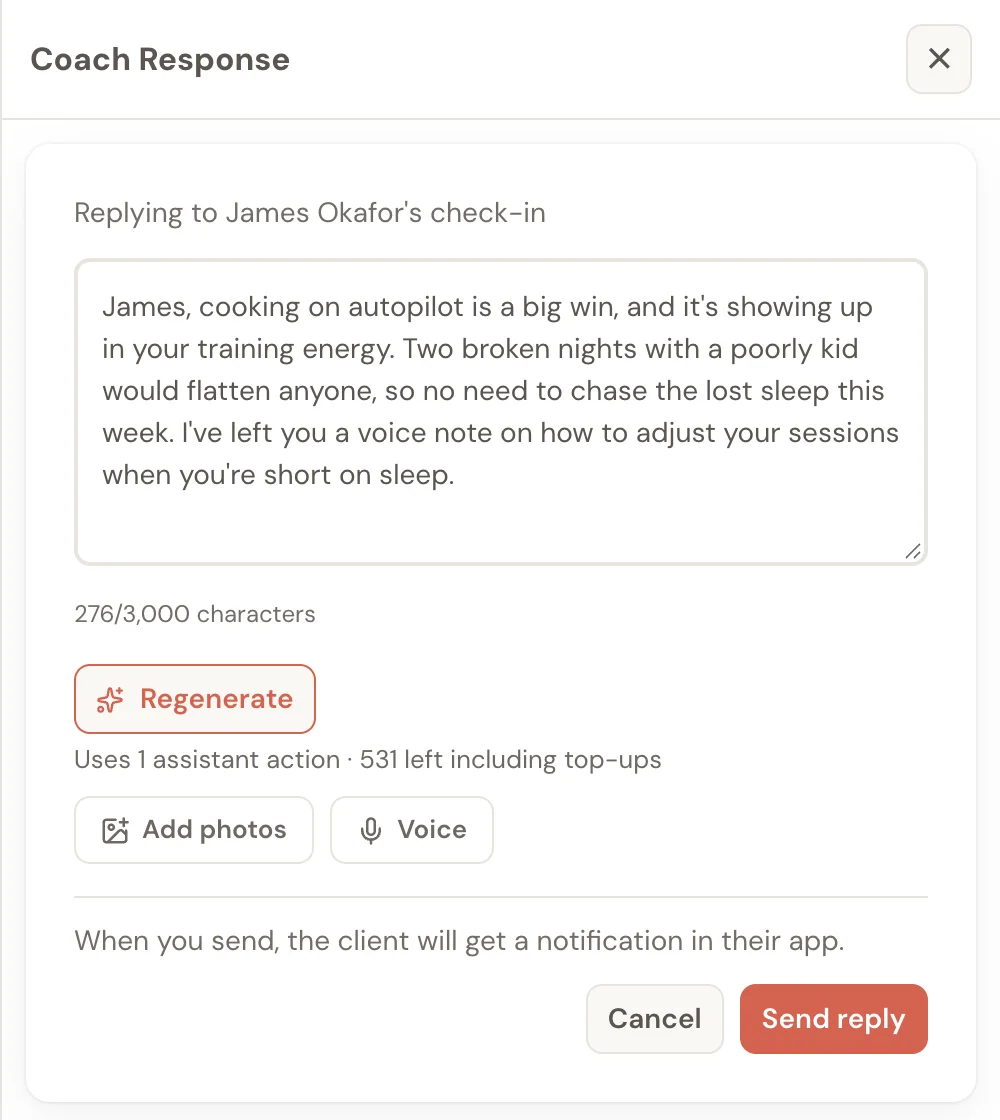
Replying to a client’s check-in in Assistant Coach.
Don’t start from a blank box. Jot notes as you review, then save your attention for the specific detail and the next step. In Assistant Coach, the same reply box can write a first draft in your style for one assistant action, which you edit before sending. For the rest of the review, see faster client check-in reviews or watch a full review and reply.
Frequently Asked Questions
How should a fitness coach respond to a client check-in?
Name one specific thing you noticed, say what it means for their goal, give one concrete next step, and end with a short question. The detail makes the client feel seen; the step gives them something to act on.
How do I reply to a check-in after a bad week?
Start with what they still did, say plainly that one week does not undo the plan, and give the smallest action that restarts their routine. Ask one question about what made the week hard, and leave judgement out of it.
How quickly should a personal trainer reply to a check-in?
Predictability matters more than speed. Tell clients when to expect a reply, for example within one working day, and keep that promise every week.
What if a client doesn’t send their check-in?
Send a short, guilt-free nudge rather than silence, and make the next one easy: ask for just their weight and sessions completed. If it keeps happening, shorten the form.
Should I use a template for check-in replies?
Template the structure, not the words. The same order every week makes replies faster to write, but the specific detail has to be fresh or clients notice the copy and paste.
References
- Gollwitzer, P. M., & Sheeran, P. (2006). Implementation intentions and goal achievement: A meta-analysis of effects and processes. Advances in Experimental Social Psychology, 38, 69–119. University of Konstanz
- Kruger, J., Epley, N., Parker, J., & Ng, Z.-W. (2005). Egocentrism over e-mail: Can we communicate as well as we think? Journal of Personality and Social Psychology, 89(6), 925–936. PDF
- Kumar, A., & Epley, N. (2021). It’s surprisingly nice to hear you: Misunderstanding the impact of communication media can lead to suboptimal choices of how to connect with others. Journal of Experimental Psychology: General, 150(3), 595–607. ScienceDaily summary
- Mohr, D. C., Cuijpers, P., & Lehman, K. (2011). Supportive accountability: A model for providing human support to enhance adherence to eHealth interventions. Journal of Medical Internet Research, 13(1), e30. PMC
- Wisniewski, B., Zierer, K., & Hattie, J. (2020). The power of feedback revisited: A meta-analysis of educational feedback research. Frontiers in Psychology, 10, 3087. PMC
 Faster Client Check-In Reviews for Fitness Coaches
 The Fitness Coaching Check-In Form Clients Actually Finish