
Should you send your fitness coaching clients voice notes? Yes, when how you say something matters as much as what you say, and no for anything they need to act on or read twice.
The research behind that split is stronger than you’d expect, and so is the evidence that many clients would rather read.
A voice note from a coach or personal trainer is a short recorded message the client plays in their own time, usually alongside a written reply to their check-in. Unlike a call, you don’t both need to be free at once. Unlike a text, the client hears your tone.
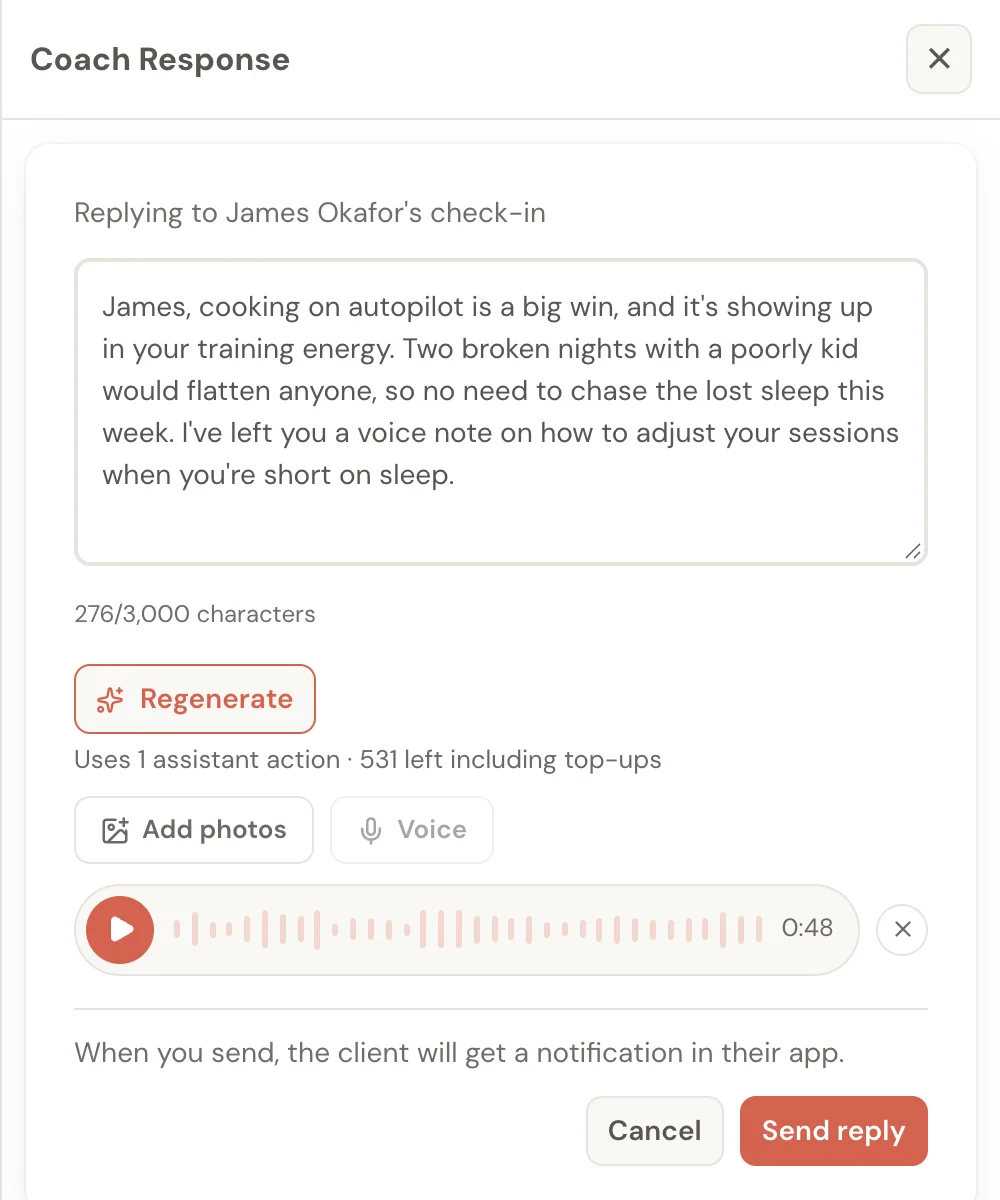
A written reply with a voice note attached, ready to send. Shown in the Assistant Coach platform.
| What it is | A short recorded message the client plays in their own time |
| Why it works | Listeners pick up tone and intent that plain text can lose |
| Best default | Text for the action, voice for the tone |
| How long | Under two minutes, one idea per note |
| The catch | Most people prefer text, and a voice note can’t be skimmed or searched |
| Where it belongs | With the check-in it’s about, not in a chat scroll |
Here’s what this guide covers:
- When voice beats text for fitness coaching clients
- How long should a voice note be for a client?
- A simple structure for a coaching voice note
- Why many personal training clients still prefer text
- How voice notes work on a fitness coaching check-in
When voice beats text for fitness coaching clients
Voice earns its place when your tone is the message; text wins when the client needs to act on the words or find them again.
| Situation | Send | Why |
|---|---|---|
| Hard news: a stall, a missed target, a plan they won’t love | Voice, with the change in text | Tone stops it reading as blame |
| Encouragement after a hard week | Voice | The warmth is the point |
| Explaining why you’re changing the plan | Voice, with the change in text | Reasoning lands better heard |
| Calories, macros, step targets | Text | They’ll look them up again |
| Exercise swaps, sets, reps, loads | Text, or update the plan | They’ll read it in the gym |
| A form correction | Comments on their set video | The fix belongs on the rep |
What the research says:
- Text drops your intent more often than you think. In a 2005 study, people sent statements meant as sarcastic or serious, typed or recorded. Listeners read the intent right nearly three-quarters of the time; readers did no better than chance, and the typists didn’t see it coming (Kruger et al.). It was small (29 pairs), but it’s why “tough week, we go again” can read as dismissive.
- Voice builds a stronger bond, without the awkwardness people fear. People who reconnected with an old friend by phone rather than email, or chatted with a stranger by voice rather than text, felt more connected and no more awkward than they predicted; audio alone matched video (Kumar and Epley). Those were live conversations, so a voice note keeping some of that warmth is a fair bet, not a finding.
- Hearing your reasoning makes you seem more thoughtful. Listeners rated someone explaining a view as more thoughtful and human than readers of the same words did, especially when they disagreed (Schroeder, Kardas and Epley). That’s the case for explaining a plan change out loud.
- Audio feedback feels more caring. Online students given audio feedback said it carried nuance better and showed the instructor cared more, and they applied audio-commented points three times as often (Ice et al.). One course of 34 students, so read it as a signal.
The best reply is often both: text for the action, voice for the tone. The written part holds the target they’ll look up on Thursday; the voice note tells them how you feel about their week.
How long should a voice note be for a client?
Keep it under two minutes, with one idea. For most check-in replies, 30 to 90 seconds is plenty.
A written reply can be scanned in seconds; a voice note costs the client its full length, at your pace, somewhere they can play sound. And talking runs longer than it feels: at the roughly 150 words a minute of ordinary conversation (Baruch College), two minutes is about 300 words, already a long message. Running past that usually means you’re covering too much: move the details into text, or book a call.
A simple structure for a coaching voice note
A good voice note sounds unscripted but isn’t aimless. Four beats cover most replies:
- Name and week. Greet them and say you’ve read their check-in.
- One specific thing you noticed, from their answers or numbers, so they know you read it.
- What it means, or what changes, and why. This is where voice earns its keep: the reasoning, the reassurance, the nudge.
- Point to the text for the details.
Here’s how that sounds for a client whose weight jumped after a weekend away:
“Hey Priya, just read your check-in. A jump after a weekend away is usually water and salt, not fat, so don’t worry about it. I’m really pleased you still got three sessions in. We’re keeping everything the same this week, and I’ve written two ideas for next weekend below. Talk soon.”
Record right after reading the check-in, and don’t read your written reply aloud. For the written half, see how to respond to client check-ins; for harder weeks, what to say after a bad week.
Why many personal training clients still prefer text
Voice notes are mainstream: WhatsApp users send about 7 billion voice messages a day (Meta’s 2022 figure, via TechCrunch). But sending them to friends isn’t the same as wanting them from your coach:
- In a 17-market YouGov survey in November 2023, 66% of people preferred sending text and 7% audio. Britons were the most text-loyal, at 83% (YouGov).
- Among British smartphone users, 25% dislike receiving voice notes and 22% like it. Young adults aged 18 to 24 are the exception: 43% like them (YouGov UK).
So ask, don’t assume: add “voice notes, text, or both?” to onboarding and note the answer. And keep the action in text, because a client on a train or in a loud gym may not play the note for hours.
How voice notes work on a fitness coaching check-in
Voice notes work best attached to the week they’re about, not lost in a WhatsApp scroll away from the numbers and photos they respond to.
In Assistant Coach, the voice note is part of the check-in reply, recorded in the same review where you’ve just read the client’s numbers, photos, and answers. In the Coach Response panel, press Voice, next to Add photos, and talk; recording stops by itself at five minutes.
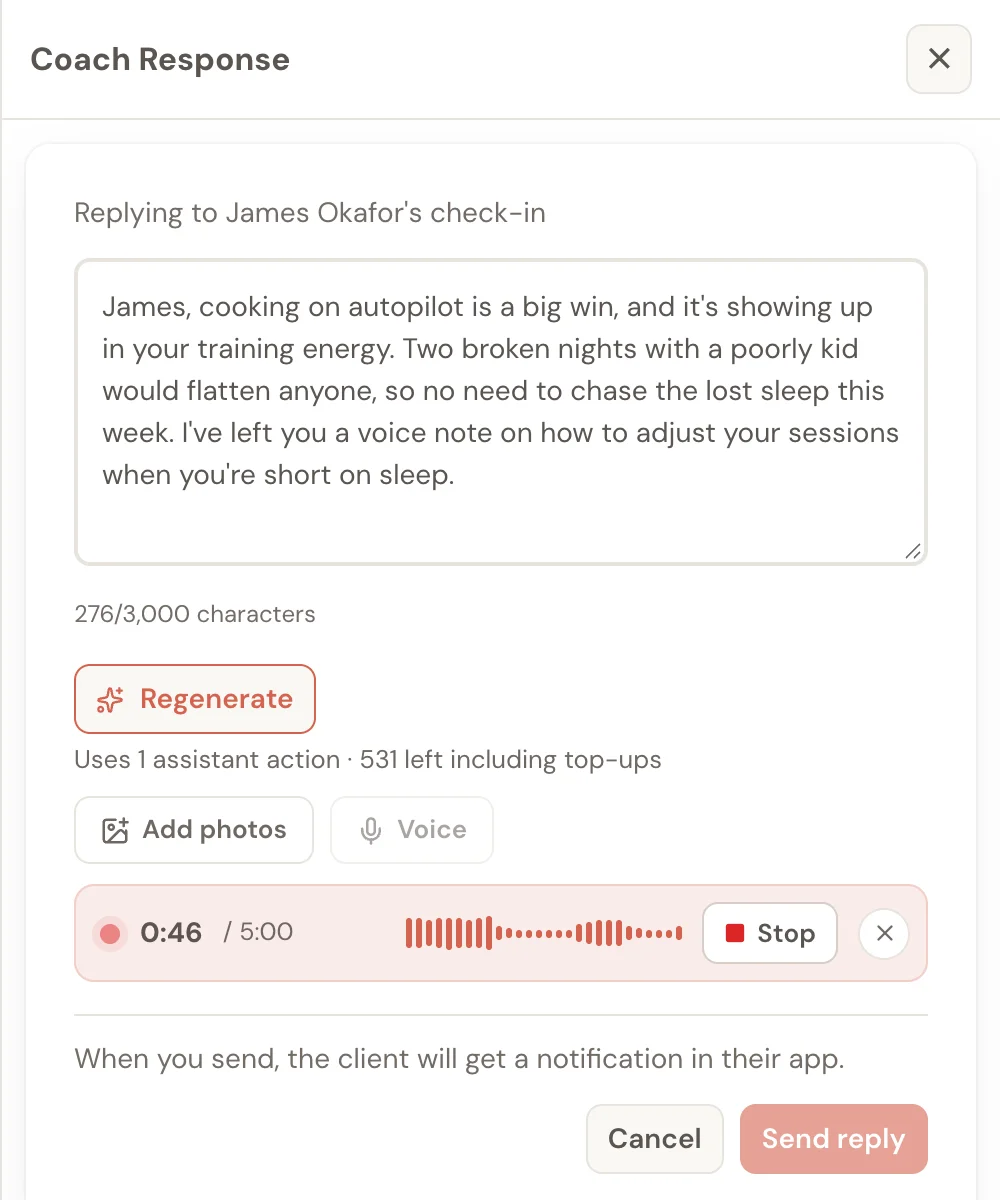
Press Stop and it uploads straight away. Send it with your written reply and photos, or on its own; remove it and re-record if the first take rambles.
Your client gets the usual reply notification and plays it in their client app, under your written reply. Either of you can download it, and it stays with that week’s check-in.
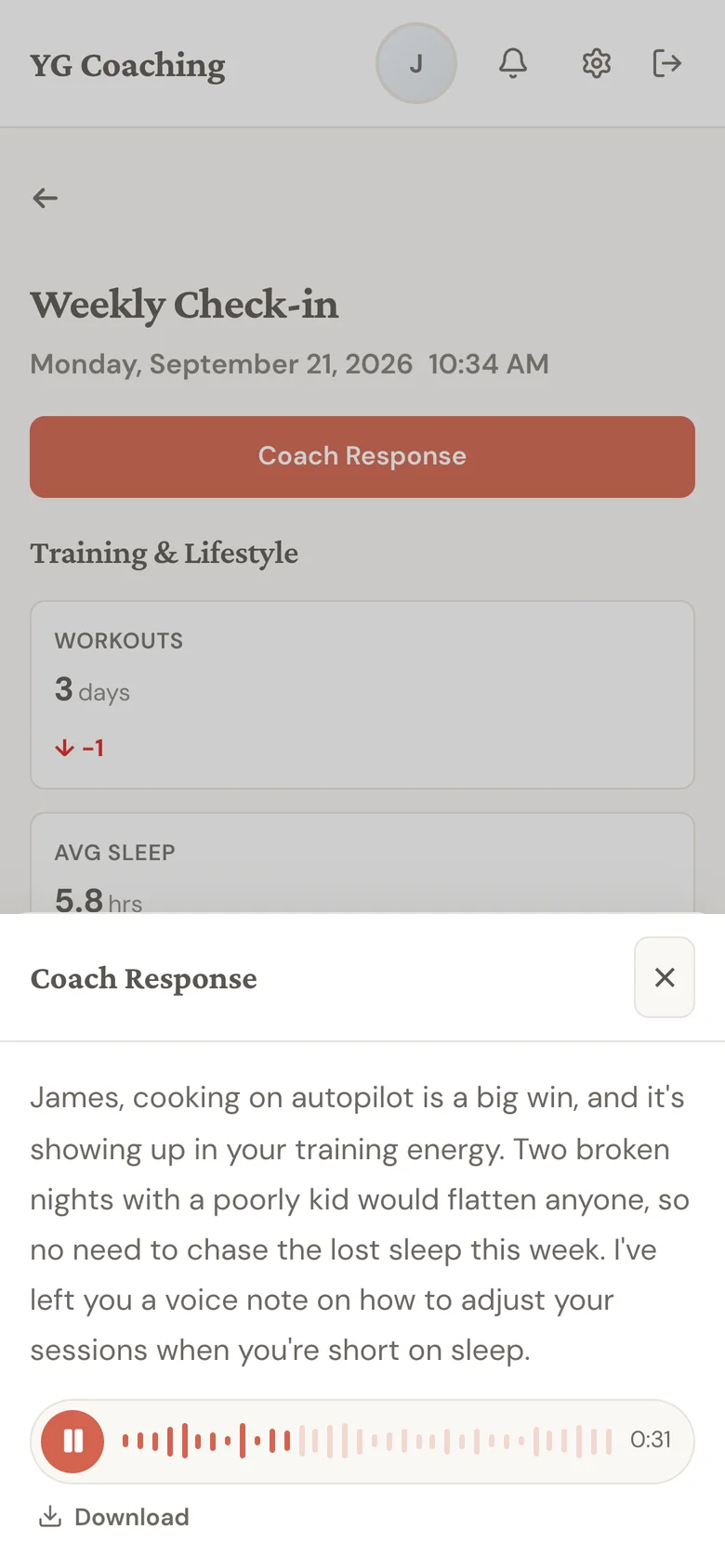
The limits, honestly: it’s for check-in replies only, not meal or workout comments. There’s no chat inbox or video yet, clients can’t reply by voice, and there’s no transcript, so keep the action in text. Recording one uses no assistant actions. Comparing tools? Here’s which coaching apps have voice feedback.
Frequently Asked Questions
Should I send voice notes to my coaching clients?
Yes, when tone matters: hard news, encouragement after a tough week, or explaining a plan change. Use text for numbers, exercise changes, and anything the client will re-read. Often the best reply is both: text for the action, a short voice note for the tone.
Are voice notes better than text for online coaching?
Neither wins everywhere. Voice carries intent that text can lose: in one study, listeners read sarcastic versus serious statements right about three-quarters of the time, while readers did no better than chance. Text is easier to skim and re-read, so it suits targets and instructions.
How long should a voice note to a client be?
Under two minutes, with one idea; 30 to 90 seconds suits most check-in replies. At a normal talking pace of about 150 words a minute, two minutes is roughly 300 words, and audio can’t be skimmed.
Do clients actually like getting voice notes?
Some do, many don’t. In a 17-market YouGov survey, 66% preferred sending text and 7% audio; in Britain, 83% preferred text. Among British smartphone users, 25% dislike receiving voice notes and 22% like it, though 43% of 18 to 24 year olds do. Ask each client.
What should a personal trainer say in a voice message to a client?
Four beats: greet them and name the week, mention one specific thing from their check-in, explain what it means or what changes and why, then point to the written reply for details.
What’s the best way to give voice feedback in online coaching?
Keep it short, put the next step in writing, and attach it to the check-in it’s about. In a personal chat, voice notes get buried in the scroll; on the check-in reply, you can both find them when you look back at that week.
References
- Kruger, J., Epley, N., Parker, J., & Ng, Z.-W. (2005). Egocentrism over e-mail: Can we communicate as well as we think? Journal of Personality and Social Psychology, 89(6), 925-936. PDF
- Kumar, A., & Epley, N. (2021). It’s surprisingly nice to hear you: Misunderstanding the impact of communication media can lead to suboptimal choices of how to connect with others. Journal of Experimental Psychology: General. PDF
- Schroeder, J., Kardas, M., & Epley, N. (2017). The humanizing voice: Speech reveals, and text conceals, a more thoughtful mind in the midst of disagreement. Psychological Science, 28(12), 1745-1762. SAGE Journals
- Ice, P., Curtis, R., Phillips, P., & Wells, J. (2007). Using asynchronous audio feedback to enhance teaching presence and students’ sense of community. Online Learning, 11(2). Online Learning
- YouGov (2024). Do consumers prefer sending and receiving messages in audio or text form? YouGov
- YouGov (2022). How many Britons like voice notes? YouGov
- Singh, M. (2022). WhatsApp tops 7 billion daily voice messages. TechCrunch
- Baruch College, Tools for Clear Speech. Speaking rate. Baruch College
 Why Fitness Coaching on WhatsApp Hits the 20-Client Wall
 The Client App That Keeps Fitness Coaching Clients