
The fastest way to make video check-in feedback worthless is to send it every week. A video from your fitness coach feels personal the first time and routine by the tenth, and a personal trainer with 25 clients can’t film them all every Sunday anyway.
The better question is which weeks earn one.
Video check-in feedback is a short recorded clip in which a fitness coach or personal trainer talks to one client, face to camera, about that client’s week. It goes with the written reply, not instead of it: the video carries your face, your tone and any movement you need to show; the text carries the steps.
| Question | Guidance |
|---|---|
| Best for | A new client’s first week, a milestone, a tough week, a new phase or plan change, showing a movement |
| Better as voice | Encouragement where only your tone matters; clients who listen on the move |
| Better as text | Targets, macros, sets and reps, anything the client will re-read |
| Length | 60 to 120 seconds, one main point |
| Setup | Light in front of you, camera at eye level, a quiet spot |
| How often | Three to five a week across a 25-client roster, picked by moment |
Here’s what this guide covers:
- When video check-in feedback beats voice and text in fitness coaching
- When voice or text is the better reply
- How to structure a 90-second video for a coaching client
- How to set up for video feedback without a studio
- How personal trainers fit video feedback into a full roster
- Keep video feedback with the fitness coaching check-in
When video check-in feedback beats voice and text in fitness coaching
Voice notes already carry your tone. Video adds two things voice can’t: your face and your body.
When Sherman, Michikyan and Greenfield (2013) had 29 pairs of close friends talk by video, audio and instant message, friends felt closer on video than over text, and smiled, nodded and gestured more on video than on audio. Closeness on video and audio didn’t differ significantly, and these were live chats, so treat your face as a warmth signal, not a guaranteed bond.
Five moments earn a video:
- A new client’s first week. The first 30 days set the tone for whether a client stays. A minute that uses their name and goal puts a face on the plan they’ve just paid for.
- A milestone. A first pull-up, twelve weeks done, a squat PR. Seeing you’re genuinely pleased beats “Great work!”
- A tough week. When a check-in reads apologetic, let them see you’re not annoyed (what to say after a bad week).
- A new phase or plan change. Explaining the why on camera shows you’ve thought it through.
- Showing a movement or position. A new exercise, how to brace, where the elbows go on a row. A meta-analysis of observational learning studies found demonstrations mainly help people copy the shape of a movement (Ashford, Bennett and Davids, 2006). To fix the client’s own rep, comment on their set video instead.
When voice or text is the better reply
Should you send a client video or voice? Most weeks, voice: it’s quicker to record, and a client walking the dog can listen but can’t watch.
Text, for anything they’ll act on. In a study of instructor feedback, Borup, West and Thomas (2015) found text more efficient and video more supportive, and students still valued text’s efficiency more.
Record the moment, write the plan. Whatever you say on camera, the new targets, swaps and next steps also go in the written reply, where the client can find them again.
How to structure a 90-second video for a coaching client
At the roughly 150 words a minute of ordinary conversation (Baruch College), 90 seconds is about 225 words: room for one idea, in four beats:
- 0:00 to 0:10, name and week. “Hi Sam, I’ve just read your check-in.”
- 0:10 to 0:40, the one thing. A specific detail from their answers, numbers or photos.
- 0:40 to 1:20, the video part. Your reaction, the reasoning behind a change, or a full-body demonstration.
- 1:20 to 1:30, hand-off. “The details are written below. Talk next week.”
A phase change, about 40 seconds out loud:
“Hi Leila, I’ve just read your week-12 check-in, and I wanted you to see my face for this one. You’re down 6 kg since March and your squat’s up 20 kg. That’s a proper result. For the next four weeks we’re moving to maintenance: calories go up, training stays the same. The new numbers are written below.”
Record right after reading the check-in. In Assistant Coach the Video button sits in the reply panel next to the client’s answers. Look at the lens rather than your own face, and allow one retake, not five.
How to set up for video feedback without a studio
Your client wants to see you, not a production:
- Light in front of you. Face a window or lamp; a bright window behind you makes you a silhouette.
- Camera at eye level. Prop the phone on a shelf or plyo box, or raise the laptop on a few books.
- A quiet spot. Gym music drowns you out; an empty studio corner or your car works.
For a demonstration, set the camera at hip height and step back until the whole movement fits.
How personal trainers fit video feedback into a full roster
For a 25-client roster:
- Moments per week: a new client, a milestone, a tough week, one or two plan changes: three to five videos.
- Time per video: 90 seconds to record, one retake, a minute to check: about five minutes.
- Weekly total: 20 to 25 minutes. Filming all 25 clients would take over two hours.
A review of video feedback in higher education found it well liked, but its effect on learning unproven, and warned that some of the enthusiasm may be novelty (Mahoney, Macfarlane and Ajjawi, 2019). A weekly video wears novelty out.
Log each client’s last video in your client notes so nobody goes three months without one, and ask at onboarding whether they prefer video, voice or text. Anything every client needs to hear, like how your check-ins work, is better recorded once and shared with everyone.
Keep video feedback with the fitness coaching check-in
A video about a client’s week is most useful next to that week’s answers, photos and written reply. In a chat app it scrolls away, the problem that makes WhatsApp coaching hit a wall at 20 clients.
In Assistant Coach, you choose a voice or video message for each check-in reply, with or without text and photos. Your client gets a notification, plays it under your written reply in their client app, and can download it. It stays with that week’s check-in, and there’s no limit on how many you send.
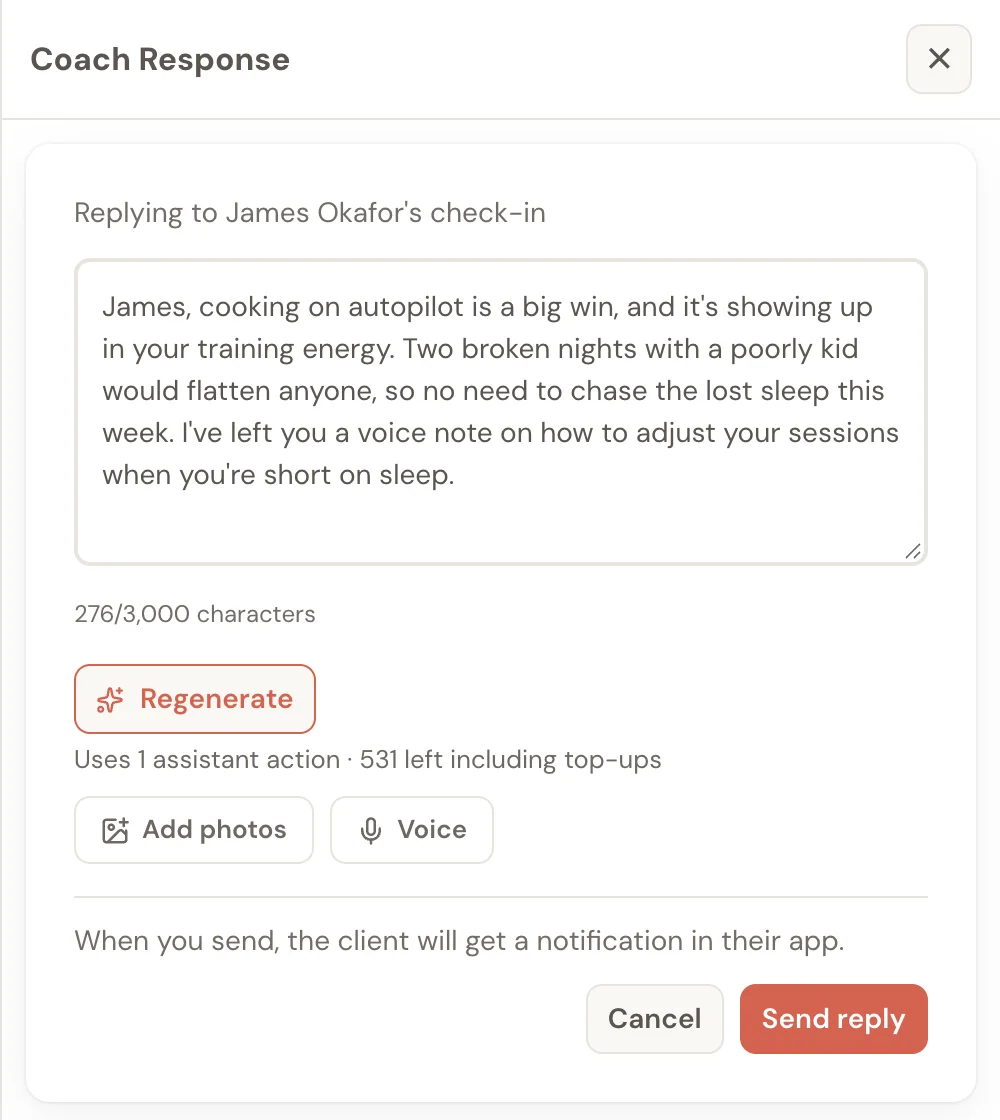
The limits: one recording per reply, check-in replies only, and clients can’t record back.
Frequently Asked Questions
When should a fitness coach send a client a video instead of a voice note?
When your face or body is the point: a first week, a milestone, a tough week, a plan change, or a demonstration. If only tone matters, send voice. Numbers belong in text.
How long should a video message to a coaching client be?
60 to 120 seconds, one main point. At about 150 words a minute, 90 seconds is roughly 225 words.
How do I record video feedback for my coaching clients?
Face a window or lamp, camera at eye level, somewhere quiet. Say their name, make one specific point, use the middle for your reaction or a demonstration, then point to the written steps.
Should I send every client a video every week?
Usually not. For 25 clients that’s over two hours a week, and it soon feels routine. Three to five chosen moments take about 20 to 25 minutes.
Is video feedback better than written feedback for online coaching?
It does a different job. In education research, video felt more supportive and text more efficient. Video for the relationship, text for the action.
Should I use Voxer or Marco Polo for client video messages?
They suit back-and-forth chat: Voxer works like a walkie-talkie for voice, and Marco Polo trades video messages. For weekly feedback, a reply attached to the check-in keeps your message next to the answers it’s about.
Which coaching apps let you send video feedback on check-ins?
My PT Hub and 1FIT offer it on check-ins, HubFit via Loom, and most others in chat. Assistant Coach records voice or video right on the check-in reply (how the apps compare).
What should a personal trainer say in a video message to a new client?
Their name, their goal, what happens this week, and when to expect your replies, with the practical steps written below.
References
- Ashford, D., Bennett, S. J., & Davids, K. (2006). Observational modeling effects for movement dynamics and movement outcome measures across differing task constraints: A meta-analysis. Journal of Motor Behavior, 38(3), 185-205. PubMed
- Borup, J., West, R. E., & Thomas, R. (2015). The impact of text versus video communication on instructor feedback in blended courses. Educational Technology Research and Development, 63(2), 161-184. ERIC
- Mahoney, P., Macfarlane, S., & Ajjawi, R. (2019). A qualitative synthesis of video feedback in higher education. Teaching in Higher Education, 24(2), 157-179. ERIC
- Sherman, L. E., Michikyan, M., & Greenfield, P. M. (2013). The effects of text, audio, video, and in-person communication on bonding between friends. Cyberpsychology: Journal of Psychosocial Research on Cyberspace, 7(2), Article 3. Cyberpsychology
- Baruch College, Tools for Clear Speech. Speaking rate. Baruch College
- Voxer. voxer.com
- Marco Polo. marcopolo.me
 Voice Notes for Fitness Coaching Clients: When to Use Them
 How to Respond to Client Check-Ins: Fitness Coach Examples