
What do you say to a client who missed three sessions, spent the weekend at a wedding and watched the scale jump 1.8 kg? Less than you think. Their check-in probably opened with an apology.
Your reply has two jobs: take the shame out of the week and give them one next step. Here’s what to say to a fitness coaching client after a bad week, with scripts by situation.
A bad-week reply is the check-in response a fitness coach or personal trainer sends when a client misses sessions, drifts off plan or gets a number they didn’t want. Its aim is to keep the client in the game, without shame.
| Situation | What they need to hear | The one next step |
|---|---|---|
| Missed workouts | One missed week doesn’t undo the ones before | Two short sessions on named days |
| Scale went up | One weigh-in is noise; the trend matters | Same plan, same weigh-in routine |
| Weekend blowout | Everyone has weekends like that | Normal plan from the next meal |
| Illness or injury | Resting was the right call | A lighter first week back |
| Work or family stress | Coaching can take a back seat | A small floor for two weeks |
| Half-empty or missing check-in | Sending anything helps | Answer one easy question |
| Wants to quit | You’d rather know; lighter options exist | Scale down, pause or leave well |
Here’s what this guide covers:
- How fitness coaches and personal trainers give tough feedback
- When a client missed workouts
- When the scale went up
- When a client ate off plan or had a weekend blowout
- When illness or injury took the week out
- When work or family stress took over
- When the check-in is half empty or missing
- When a client wants to quit
- Why a voice note suits hard-week replies in fitness coaching
How fitness coaches and personal trainers give tough feedback
Tough feedback after a bad week isn’t harsh, and an encouraging check-in response isn’t cheerleading. Both are honest about the week and kind about the person, with no lecture and no heroic week to make up for it.
Kindness is what gets people trying again. Across four experiments, Breines and Chen (2012) found that people nudged toward self-compassion after a failure were more motivated to improve.
Every script below names the problem once, shrinks the ask and ends on one next step. For the structure behind every reply, see how to reply to client check-ins.
In Assistant Coach you reply on the check-in itself, and Generate draft writes a first pass in your usual style from the client’s answers, your notes and past replies. On a hard week, add a note first (“rough week, keep it short and warm”), then write the opening line yourself.
When a client missed workouts
Missed sessions feel huge to the client and usually aren’t. In a real-world study of habit formation, Lally and colleagues (2010) found that missing a single day of a new daily habit made little difference; repeated misses added up.
Example reply:
“Thanks for being straight with me. One missed week doesn’t undo the eight good ones before it. What got in the way? This week, forget the full plan: two 30-minute sessions on your quietest days. Tell me which days and I’ll trim the workouts to fit.”
Avoid: asking them to make up the sessions. Doubling next week is how one missed week becomes three. Two missed weeks in a row is the never-miss-twice line, where a proper conversation starts.
When the scale went up
After a salty, carb-heavy weekend, most of a jump on the scale is usually water, not fat, as why scale weight misleads coaches explains. The client needs evidence, not a lesson.
Example reply:
“I know seeing 1.4 kg more stings. Two restaurant meals and short sleep will do that, and it’s mostly water, not fat. Your four-week average is still heading the right way, so the plan stays. Weigh in the same way this week and we’ll check the trend together.”
Avoid: cutting calories or adding cardio over one reading. It teaches clients that a bad number earns a punishment.
When a client ate off plan or had a weekend blowout
The danger is the “I’ve blown it anyway” spiral after the weekend, and kindness interrupts it. In a small study of 84 female students, Adams and Leary (2007) gave some of them a doughnut. The strictest dieters who were then told not to be hard on themselves, because everyone eats unhealthily sometimes, ate less candy afterwards. Those told nothing ate as much as if they’d never had the doughnut.
Example reply:
“Sounds like the weekend got away from you, and that’s fine. Everyone has weekends like that. Don’t skip meals to make up for it; that usually sets up the next big night. Just go back to your normal plan at your next meal. Want to plan one meal out next weekend that you’ll really enjoy?”
Avoid: “cheat”, “damage”, “bad food”, and any plan to compensate.
When illness or injury took the week out
Here the client needs permission more than a plan.
Example reply:
“Sorry you’ve been ill. Resting was the right call, and we’ll pick things up when you feel properly better, not before. Your first week back will be lighter so you can ease in. Message me when you’re ready.”
For pain or injury, keep the same shape, ask them to see a physio or doctor before you load it again, and train around what they can do. Avoid: diagnosing, or telling them to push through.
When work or family stress took over
When life gets loud, the plan gets quieter. Swap the full plan for a floor: the smallest version worth keeping.
Example reply:
“That sounds like a really heavy week, and I’m glad you still checked in. Training and food can take a back seat while things settle. For the next two weeks, the floor is two short sessions and some protein at each meal. Anything more is a bonus.”
Avoid: extra tracking, self-care homework, or anything that sounds like “stress is no excuse”.
If a client mentions something beyond coaching, point them to someone qualified. For low mood that won’t lift or eating that feels out of control, thank them for telling you and suggest their doctor or a qualified professional. Keep coaching alongside that support.
When the check-in is half empty or missing
A half-finished check-in is still a check-in, and it tells you the week was hard.
Example reply:
“Thanks for sending this, even in a messy week. It’s still useful to me. One question when you have a second: what was the hardest part of the week? One line is plenty.”
Avoid: pointing at blank fields. If nothing arrives, send a no-pressure nudge: “Haven’t heard from you this week, no stress. Just checking you’re okay.” If the silence repeats, check the longer trend before assuming it’s motivation.
When a client wants to quit
Ask what changed, offer a lighter version, and make leaving easy if they still want to go. Clients who leave on good terms can come back or refer a friend.
Example reply:
“Thanks for telling me honestly. I’d much rather know. What’s changed? If it’s time, money or just feeling flat, we could drop to fewer sessions, simplify your food target or pause for a month. If you’d still rather stop, that’s okay, and I’ll send you your current plan to keep going on your own.”
Avoid: guilt (“after all the work we’ve put in”) or leading with a discount.
Why a voice note suits hard-week replies in fitness coaching
Tone matters most on a hard week, and text strips it out. In one small experiment by Kruger, Epley and colleagues (2005), people who heard a statement spoken could tell whether it was sarcastic or serious nearly three-quarters of the time. People who read it in an email did no better than chance, and the senders didn’t see it coming. “No stress, seriously” can read as passive-aggressive in text and sound kind out loud.
Clients can’t skim a voice note, so keep it to a minute or two and put the next step in writing too. Voice notes for coaching clients goes deeper.
In Assistant Coach, the voice note (up to five minutes) is part of the check-in reply: you record it next to your written reply, in the same review where you’ve just read the client’s answers. The client gets a notification, listens in their client app, and the note stays with the week it’s about.
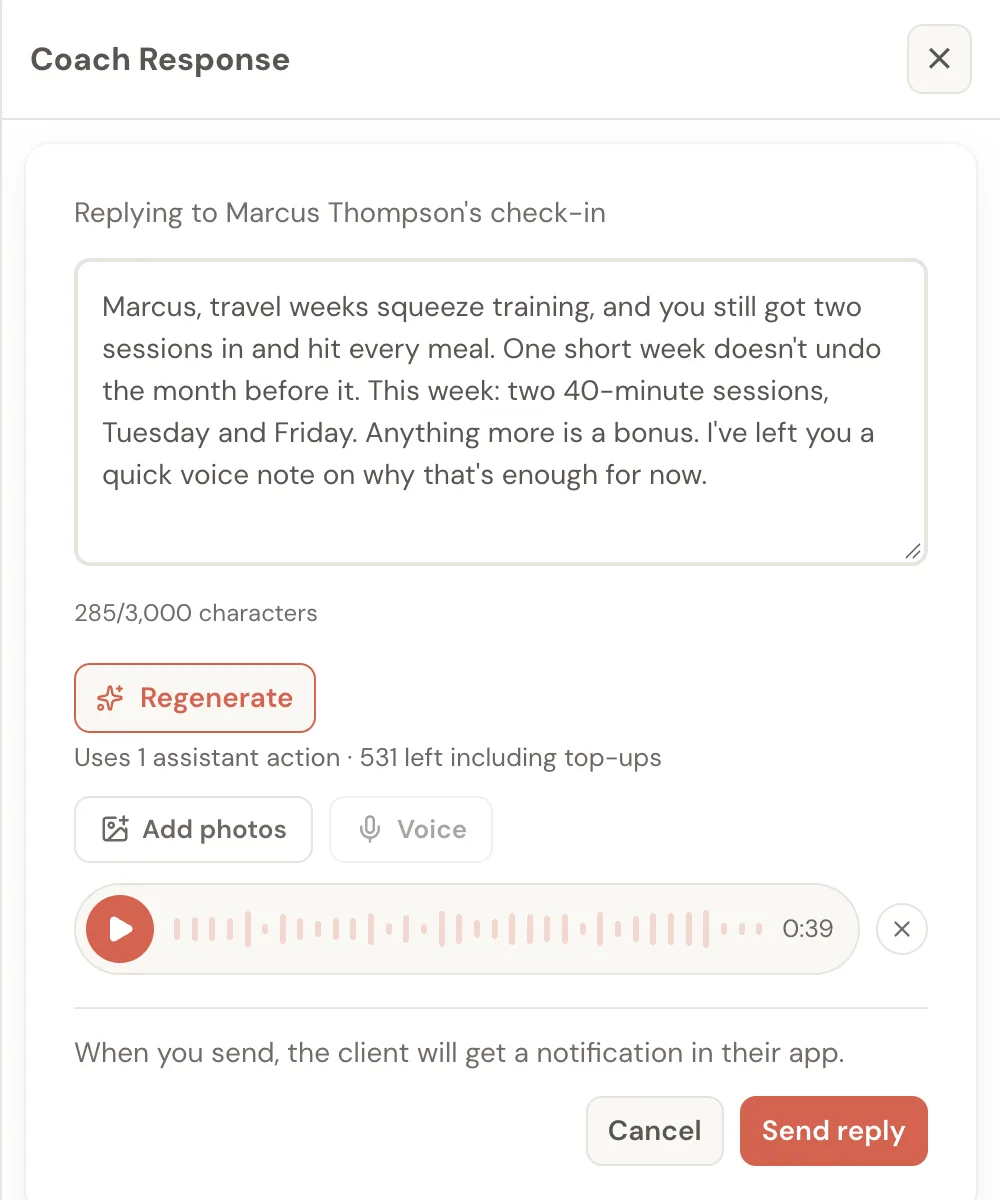
The next step in writing, the tone in the voice note.
Frequently Asked Questions
What should I say to a client who had a bad week or fell off track?
Name what happened once, without blame, make next week smaller and give one next step. Skip the lecture; they already know. The goal is to keep them checking in.
What message should I send a client who missed workouts?
Thank them for being honest, say one missed week doesn’t undo the work before it, and ask what got in the way. Then set a smaller target, like two short sessions on named days.
How do you give tough feedback to coaching clients without demotivating them?
Be honest about the facts and kind about the person: name the issue plainly and offer one doable next step. People who meet a setback with self-compassion tend to be more motivated to improve, not less.
What should a personal trainer say when a client wants to quit?
Thank them, ask what has changed, and offer lighter options such as fewer sessions or a short pause. If they still want to stop, make leaving easy and leave the door open.
Should I reply to a bad week with a voice note or a written message?
Both, if you can. A short voice note carries warmth that text can lose, so it suits a hard week. Put the next step in writing too, so the client can re-read it.
References
- Adams, C. E., & Leary, M. R. (2007). Promoting self-compassionate attitudes toward eating among restrictive and guilty eaters. Journal of Social and Clinical Psychology, 26(10), 1120–1144. Duke Scholars
- Breines, J. G., & Chen, S. (2012). Self-compassion increases self-improvement motivation. Personality and Social Psychology Bulletin, 38(9), 1133–1143. PubMed
- Kruger, J., Epley, N., Parker, J., & Ng, Z.-W. (2005). Egocentrism over e-mail: Can we communicate as well as we think? Journal of Personality and Social Psychology, 89(6), 925–936. PDF
- Lally, P., van Jaarsveld, C. H. M., Potts, H. W. W., & Wardle, J. (2010). How are habits formed: Modelling habit formation in the real world. European Journal of Social Psychology, 40(6), 998–1009. Wiley
 Why Fitness Coaching Goals Fail Without Weekly Habits
 The Fitness Coaching Check-In Form Clients Actually Finish